
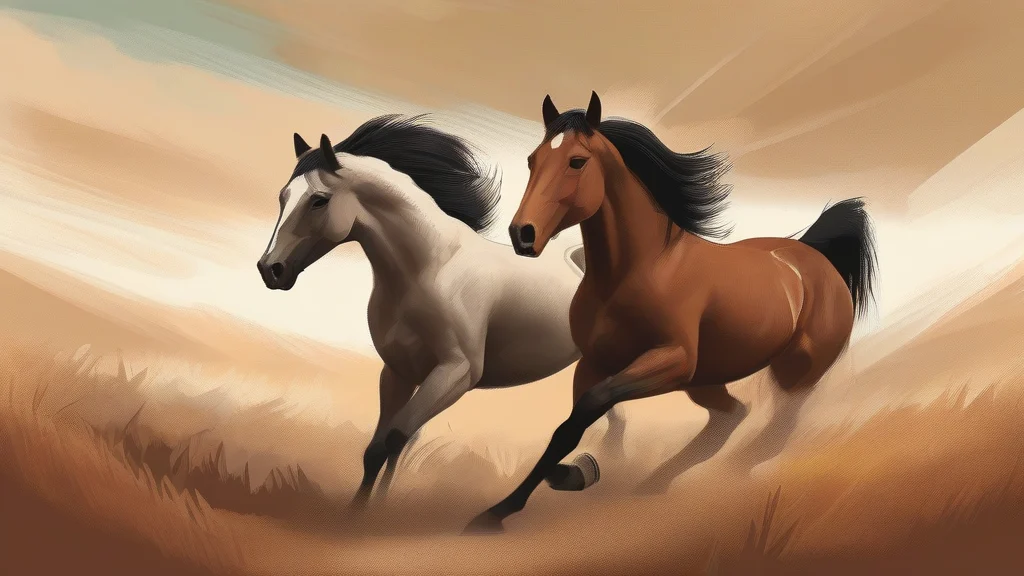
What does coltish mean?
Coltish is an adjective describing someone — usually a young person — who is lively, playful, and exuberant but also somewhat awkward or ungraceful, much like a young horse finding its footing. The word derives from 'colt,' the term for a male foal, combined with the suffix '-ish.' It carries an affectionate connotation: the clumsiness it suggests is endearing rather than blameworthy, evoking gangly limbs, boundless energy, and an appealing lack of self-consciousness. Writers and critics often apply it to adolescents, debutantes, dancers, or actors in their first roles, as in 'her coltish charm won over the audience.' Its derivatives are rare but attested: the adverb 'coltishly' and the noun 'coltishness.' Because it blends vitality with imperfection, coltish is a useful word for praising someone's spirit without implying polished skill — capturing that fleeting stage between childhood and composure when energy outpaces grace. It appears in both British and American English, generally in literary or journalistic prose rather than casual speech.
adjectivePlayful, lively, and awkwardly exuberant in the manner of a young horse; energetic but lacking polish or grace.
- (of a person or their movements) Playfully lively and energetic but awkward or ungraceful, like a young horse.
- (figuratively) Characterized by youthful, unpolished high spirits.
"Her coltish enthusiasm lit up the rehearsal room, even when she stumbled over the steps."
"The coltish teenager bounded down the stairs two at a time, nearly tripping on the last step."
"Critics praised her coltish screen presence — raw, buoyant, and utterly unselfconscious."
Calling someone 'coltish' compares them to a young horse — all legs, all energy, zero elegance — and somehow it's a compliment.
Reviewed by Deb Chak, Editor. AI-assisted content curated by RJS Tech Solutions LLP.
Etymology of coltish
Coltish combines 'colt' — the Middle English word for a young horse, itself possibly from Old Norse, though its deeper origins are uncertain — with the adjectival suffix '-ish,' which forms words meaning 'having the qualities of.' The compound arose in English by at least the sixteenth century, following the pattern of other animal-based descriptors such as 'owlish' and 'sheepish.' Its figurative extension to people's playful, ungraceful energy developed naturally from the image of a frisky foal. There are no widely recognized cognates beyond this Germanic root lineage.
Related word forms
How coltish is actually used
Coltish is almost always used approvingly or affectionately; the awkwardness it implies is charming rather than clumsy in a negative sense. It typically describes young people, especially girls and young women, or the early stages of a performance career. The register is literary to neutral rather than colloquial.
Easily confused with coltish
Cultish describes behavior characteristic of a cult or its devoted followers, while coltish describes playful, ungainly youthful energy.