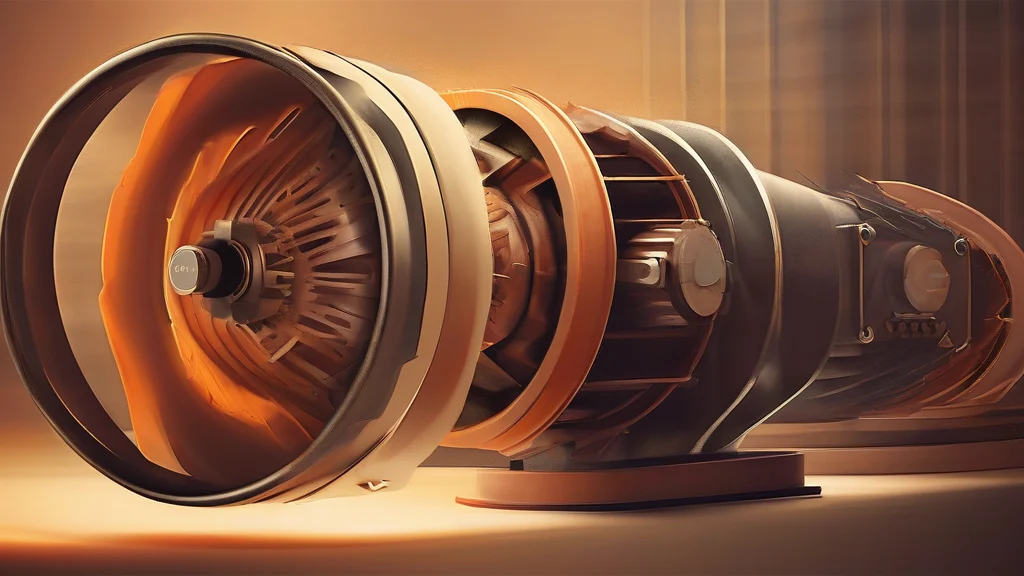
What does commutator mean?
A commutator is a mechanical component found in direct-current motors and generators, consisting of a cylindrical assembly of copper segments insulated from one another, against which stationary carbon brushes press. As the armature spins, the commutator periodically reverses the direction of current flowing through its windings, ensuring that torque continues to act in the same rotational direction — without it, a simple DC motor could not turn continuously. The word also has a distinct life in higher mathematics: the commutator of two elements measures how badly they fail to commute, appearing in group theory, ring theory, and quantum mechanics, where the commutator of position and momentum underlies Heisenberg's uncertainty principle. Both senses derive from the Latin root commutare, meaning 'to change' or 'to exchange', aptly describing something built on reversal. The term is technical rather than colloquial, encountered chiefly in engineering texts, physics courses, and mathematics.
A device consisting of a set of insulated copper segments mounted on the shaft of a DC motor or generator, working with brushes to reverse the direction of current between the windings and the external circuit.
"Over years of use, the brushes gradually wore down the copper segments of the commutator."
Almost always discussed in the context of brushed DC machines or universal motors.
In mathematics, an expression — aba⁻¹b⁻¹ in group theory, or ab − ba in algebras and quantum mechanics — that quantifies the failure of two elements or operators to commute.
"If the commutator of two observables vanishes, those observables can be measured simultaneously with arbitrary precision."
Standard English plural; used freely in both the electrical and mathematical senses.
"The workshop stocked replacement commutators for several models of industrial motor."
The humble commutator — a spinning copper ring that flips current back and forth dozens of times per second — is what made the first practical electric motors possible in the 1830s.
Reviewed by Deb Chak, Editor. AI-assisted content curated by RJS Tech Solutions LLP.
Etymology of commutator
The word commutator derives from the Latin verb commutare, formed from com- ('together') plus mutare ('to change'), giving the sense 'to exchange or alter'. It entered English via the noun commutation, borrowed from Latin through French, and was applied in the nineteenth century to the electrical device that repeatedly changes or reverses current direction. The same root yields commute (both in the sense of exchanging one thing for another and, later, regular travel), communicable, and common itself. Its mathematical usage arose in the late nineteenth century as algebraists formalized the study of non-commuting operations.
Related word forms
How commutator is actually used
Primarily a technical term used by electrical engineers, physicists, and mathematicians; rare in everyday conversation. In physics, 'commutator' often refers specifically to the operator bracket [A, B] = AB − BA in quantum mechanics, where non-vanishing commutators express uncertainty relations. The plural is simply 'commutators'.
Easily confused with commutator
A commuter is a person who travels regularly between home and work, whereas a commutator is either an electrical device or a mathematical expression.