
What does compass mean?
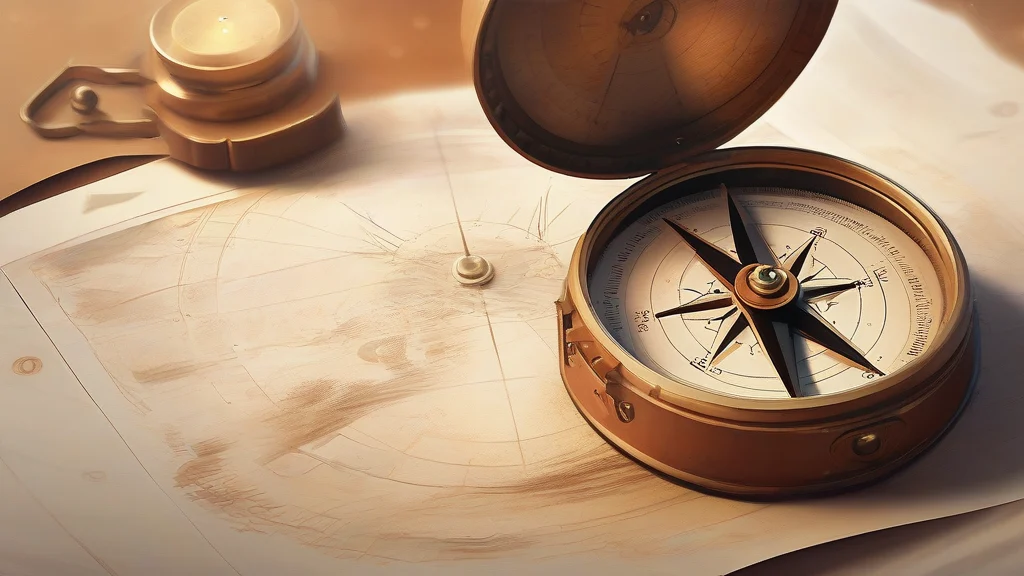
A compass is best known as a navigational instrument containing a magnetized needle that aligns itself with Earth's magnetic field, pointing toward magnetic north and allowing travellers to determine direction even without visible landmarks. A second, older meaning describes a drafting tool with two hinged legs used to draw circles and measure distance, often called a pair of compasses. Beyond these physical senses, compass carries a figurative meaning of range or scope — the limits within which something exists or operates, as in 'beyond the compass of this book'. In modern usage it also appears idiomatically in phrases such as 'moral compass', denoting an inner guide to ethical behaviour. The word derives from Old French 'compas', from Vulgar Latin *compasso*, related to 'com-' (together) and 'passus' (a step or pace), reflecting its origins in measurement rather than navigation. Whether guiding sailors across open oceans or framing the extent of an argument, compass remains a word about orientation, precision, and limits.
An instrument with a magnetized needle that points toward magnetic north, used to find direction in navigation.
"He adjusted his compass and set off due east across the moor."
Often paired with a map in land navigation; the needle points to magnetic north, not true north, so users must correct for local declination.
A two-legged hinged tool used in geometry and technical drawing to draw circles or arcs and to transfer measurements; commonly called a pair of compasses in British English.
"Use your compass to draw a circle with a six-centimetre radius."
The range, scope, or boundary of something; the extent within which something falls or operates.
"The question lies outside the compass of today's discussion."
This sense is relatively formal and literary, common in academic and legal writing.
(Archaic or literary) To surround, enclose, or encompass; also to achieve or contrive by scheming.
"They compassed the city on every side."
Now rare except in literary or biblical language; the modern equivalent is 'encompass'.
As a countable noun, the plural is 'compasses'. Note that in British English 'a pair of compasses' refers to the single drawing tool, analogous to 'a pair of scissors'.
"The ship carried several compasses as backups in case of equipment failure."
The word 'compass' comes from Latin roots meaning 'to measure together' — long before it pointed north, it measured out circles and boundaries.
Reviewed by Deb Chak, Editor. AI-assisted content curated by RJS Tech Solutions LLP.
Etymology of compass
Compass entered Middle English from Old French 'compas', which derived from Vulgar Latin *compasso, a combination of 'com-' ('together') and 'passus' ('a pace or step'), originally suggesting the act of pacing off or measuring equally together. Its earliest English senses concerned measurement and circumscribing — drawing circles and defining bounds — before the navigational sense of the magnetic direction-finder became established by the early modern period. It shares its Latin root family with words like 'pace' and, through broader Romance development, with terms such as 'encircle'-type derivatives like 'encompass'.
Related word forms
How compass is actually used
In British English, the drawing instrument is typically called 'a pair of compasses', while American English usually treats 'compass' as singular. The figurative sense of 'range or scope' is somewhat formal and literary. The phrase 'moral compass' is a common idiomatic extension referring to a person's inner sense of right and wrong.