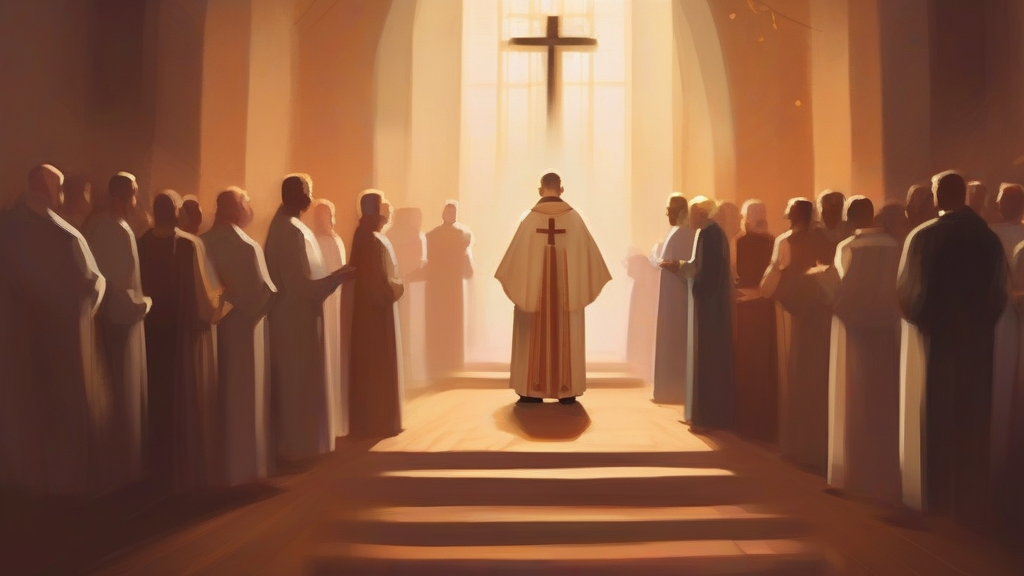
What does concelebrant mean?
A concelebrant is a member of the clergy — typically a bishop, priest, or minister — who takes part in celebrating the Eucharist together with other clergy rather than presiding over the rite alone. The term belongs almost exclusively to Christian liturgical language, appearing most often in Roman Catholic, Eastern Orthodox, and Anglican contexts. In such services, one cleric usually acts as the principal celebrant while the others serve as concelebrants, sharing in prayers and ritual actions; at major events such as ordinations or papal Masses, dozens or even hundreds of concelebrants may participate. The word derives from Latin roots: con- meaning 'together' and celabrare (celebrare) meaning to perform solemnly or observe rites. Its everyday relatives include celebrate and celebration, but its own family is narrow — chiefly the verb concelebrate and noun concelebration. Formal in tone and precise in application, concelebrant signals shared liturgical presidency and is best reserved for explicitly religious settings.
nounA priest or bishop who celebrates the Eucharist jointly with one or more other clergy rather than alone; a co-celebrant of a liturgical rite.
- A bishop, priest, or (in some traditions) minister who joins others in celebrating the Eucharist as a shared act, rather than presiding alone.
"The bishop was joined by six concelebrants at the anniversary Mass."
"At the ordination, more than forty priests served as concelebrants behind the new bishop."
"As principal concelebrant, the abbot read the eucharistic prayer while the visiting clergy joined in the responses."
Regular plural; commonly used when referring to groups of clergy at large liturgical gatherings.
"More than two hundred concelebrants processed into the basilica."
In Catholic practice, up to hundreds of priests can concelebrate a single Mass — each one technically a concelebrant of the same Eucharist.
Reviewed by Deb Chak, Editor. AI-assisted content curated by RJS Tech Solutions LLP.
Etymology of concelebrant
Concelebrant comes from the Latin prefix con-, meaning 'together with,' joined to celebrare, 'to perform solemnly or frequent,' which also gives us celebrate, celebration, and celebrant. The term entered English through ecclesiastical Latin, where concelebratio described the joint celebration of the Eucharist by multiple bishops or priests — an ancient practice attested from the early centuries of Christianity. It became especially prominent in English-language liturgical discussion after the Second Vatican Council (1962–65) encouraged concelebrated Masses, and its derivatives concelebrate and concelebration share the same formation.
Related word forms
How concelebrant is actually used
Concelebrant is almost entirely restricted to ecclesiastical contexts — chiefly Roman Catholic, Eastern Orthodox, and Anglican worship — and carries no secular use. It is formal and technical in register. The related verb is 'to concelebrate,' and the practice itself is 'concelebration.' In Catholic usage since Vatican II, concelebration at large gatherings has become common, making the word familiar to regular churchgoers though still specialized vocabulary for most English speakers.
Easily confused with concelebrant
A celebrant is any officiant who performs a religious or ceremonial rite, while a concelebrant is specifically a cleric who shares in celebrating a Eucharistic rite alongside other clergy.