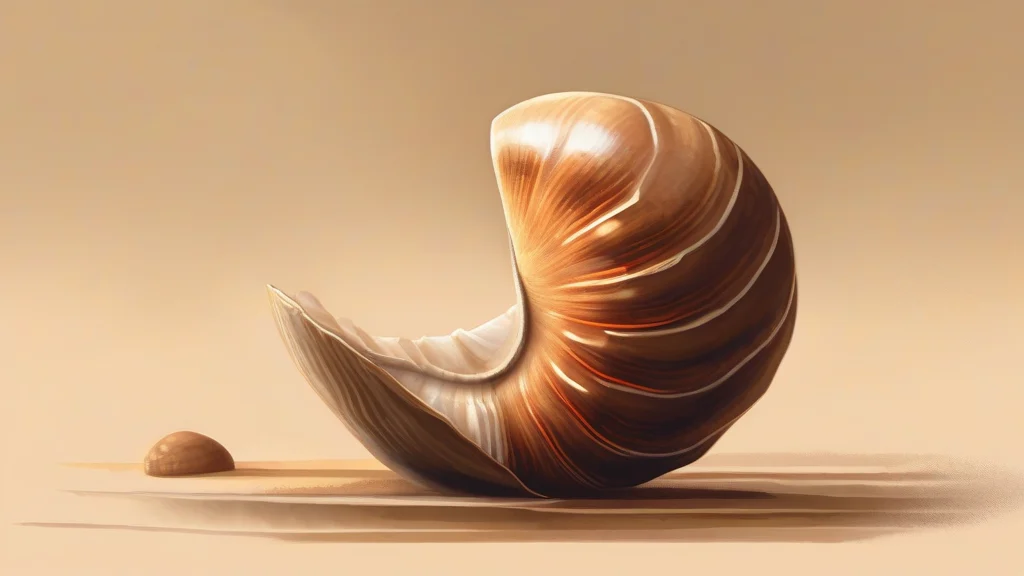
What does conchoidal mean?
Conchoidal is an adjective used chiefly in mineralogy and geology to describe a distinctive way certain brittle materials break: rather than splitting along flat cleavage planes, they fracture into smooth, curved surfaces marked by concentric ripples, resembling the inside of a clamshell or mussel. The term derives ultimately from Greek 'konchē', meaning mussel or shell, reflecting the resemblance early naturalists noticed. Conchoidal fracture is characteristic of amorphous or fine-grained substances such as obsidian, flint, chert, and glass. This property made such materials invaluable to prehistoric peoples, since striking them produces flakes with keen, predictable edges — the basis of Stone Age toolmaking. Archaeologists studying ancient lithics rely on understanding conchoidal behavior to reconstruct how tools were manufactured. Outside technical contexts the word appears occasionally in broader descriptions of anything shell-shaped, but its dominant use remains firmly scientific.
adjectiveRelating to or having a shell-like form; in mineralogy, describing a fracture surface that breaks into smooth, curved depressions resembling the interior of a bivalve shell.
- (Mineralogy) Of a fracture surface: breaking to produce smooth, concentrically curved surfaces resembling a shell's interior.
- Of or relating to shells or a shell-like shape in general.
"Obsidian is prized by knappers for its conchoidal fracture, which yields razor-sharp edges when struck."
"The knapper exploited the flint's conchoidal fracture to detach a thin, razor-edged flake."
"Quartz typically displays a conchoidal break rather than cleaving along flat planes."
When obsidian fractures, it doesn't splinter — it peels away in smooth, glassy curves shaped like a seashell, which is exactly what 'conchoidal' means.
Reviewed by Deb Chak, Editor. AI-assisted content curated by RJS Tech Solutions LLP.
Etymology of conchoidal
Conchoidal comes from the Greek 'konchē' (mussel, shell), which passed into Latin as 'concha' before entering English. The combining form '-oidal' means 'resembling'. The word was adopted into English scientific vocabulary in the 19th century, when mineralogists formalized terms for fracture types. It shares its root with words like 'conch' and 'conchology', the study of mollusc shells.
How conchoidal is actually used
Primarily a technical term used in geology, mineralogy, and archaeology; rarely encountered outside these fields except in descriptions of glassy materials such as obsidian, flint, and quartz. It carries no emotional connotation and is neutral in register, though distinctly formal-scientific.
Easily confused with conchoidal
A conchoid is a specific mathematical curve defined relative to a point and a line, whereas conchoidal describes any shell-like shape — most famously the curved fracture pattern seen in minerals.