What does conferva mean?
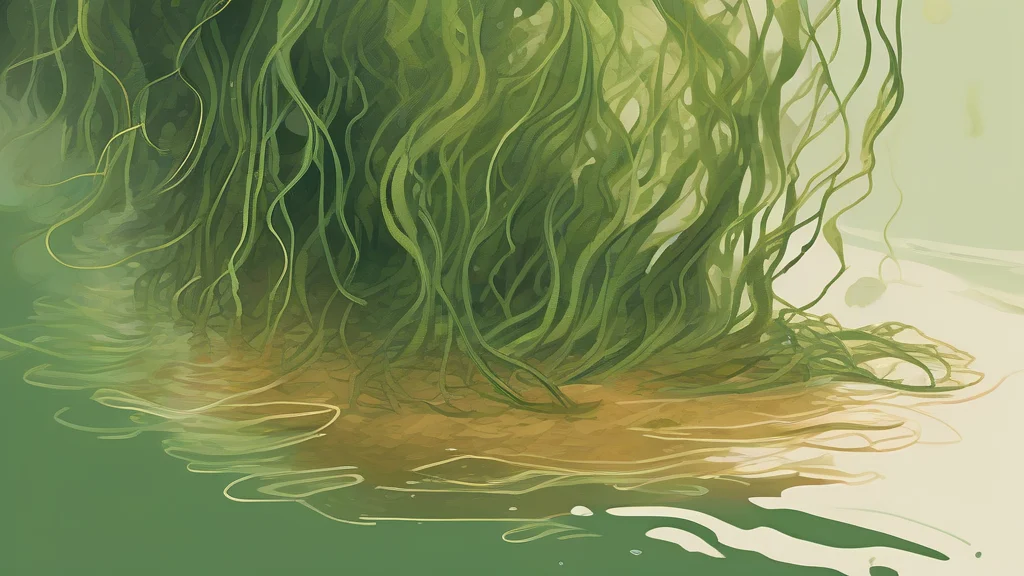
Conferva is the name given to certain filamentous green algae — simple plants made up of fine, thread-like strands — that grow in fresh or stagnant water, where they often form soft, tangled green mats on stones, pondweeds, and submerged surfaces. Historically, all such thread algae were lumped into a single genus, Conferva, but as microscopy advanced, botanists realised these organisms belonged to several distinct groups, and the name survives mainly as a broad, somewhat dated label. In use, conferva appears almost exclusively in scientific, historical, or literary contexts: a Victorian naturalist might describe a canal 'overgrown with conferva', for instance. The word carries a faintly antiquarian flavour today, evoking old field guides and pond-side observation. Its chief interest lies in its history: in the seventeenth century, observations of conferva contributed to debates about spontaneous generation. For readers of older natural-history writing, recognising the word unlocks descriptions of aquatic landscapes that modern terminology would render differently.
nounA conferva is any of various filamentous green algae, especially of the genus Conferva, that form tangled masses in fresh or stagnant water. The term is now largely historical or technical, used chiefly in older botanical literature.
- Any of various filamentous green algae forming tangled masses in freshwater, formerly classified in the genus Conferva and now distributed among several genera.
"The old millpond was choked with a green felt of conferva clinging to the stones."
"She lifted a handful of conferva from the stream, its silky threads trailing in the current."
"Nineteenth-century naturalists catalogued the conferva growing along the canal with meticulous care."
The Latin-style plural confervae appears mainly in older scientific literature; anglicised plurals such as confervas also occur, though the word is most often treated as uncountable.
"Early microscopists described dozens of species of confervae in their surveys of pond life."
Before microscopes settled the matter, the green threads called 'conferva' were so puzzling that they helped spark early debates about whether life could arise spontaneously — this humble pond scum once sat at the centre of a major scientific controversy.
Reviewed by Deb Chak, Editor. AI-assisted content curated by RJS Tech Solutions LLP.
Etymology of conferva
The word conferva comes from Latin confervae, the classical name for certain water weeds or algae, a plural form derived from confervere, meaning 'to boil together' or 'to ferment' — an apparent reference to the way masses of these algae seem to bubble or froth in water. English adopted the term in the sixteenth century as a botanical name for thread-like freshwater algae. It is cognate with Latin words built on the same root as fervere, 'to boil', which also underlies English words such as effervesce and ferment.
How conferva is actually used
Conferva is a scientific and somewhat archaic term, encountered mainly in historical botany texts rather than everyday speech. It is a mass noun when referring to the algae collectively, though plural forms occur in older literature. Modern biology generally uses more precise genus names instead.
Easily confused with conferva
A conifer is a cone-bearing tree such as a pine or spruce, whereas conferva is a filamentous water alga.