What does congee mean?
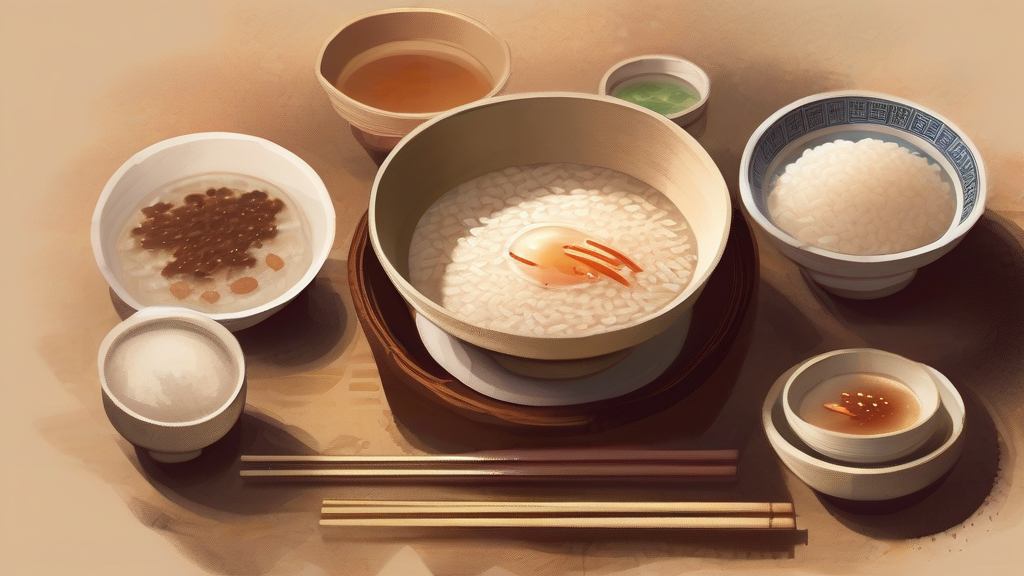
Congee is a rice porridge made by simmering rice in far more water than usual until the grains soften and dissolve into a smooth, soupy consistency. A staple across China, Japan, Korea, Southeast Asia, and South Asia, it goes by many local names — zhou in Mandarin, okayu in Japanese, juk or jok elsewhere — and serves both as everyday comfort food and as the classic dish for the ill or convalescing. It may be served plain or enriched with toppings such as preserved egg, shredded chicken, ginger, spring onion, or fried dough. In English, 'congee' functions as a straightforward culinary noun, most often encountered on menus and in food writing describing Asian cuisine. Its warmth and simplicity have given it affectionate connotations of home, care, and recovery. The word itself entered English in the early modern period, borrowed through Portuguese from a South Indian source, making this humble dish's name a small record of global trade routes.
nounA thin rice porridge or gruel, eaten especially in East and Southeast Asia, made by boiling rice in a large amount of water until it breaks down into a soft, soupy consistency.
- A soft rice porridge, boiled until creamy, eaten as a staple breakfast or sick-day food throughout East and Southeast Asia.
"For breakfast she ordered a steaming bowl of congee topped with century egg and scallions."
"Her grandmother's congee, simmered low with ginger and dried scallop, was the household's cure for any illness."
"Street vendors in Bangkok ladle out jok at dawn, garnishing each bowl of congee with pork floss and white pepper."
The plural is grammatically valid but uncommon; speakers normally treat congee as a mass noun and quantify it with phrases like 'a bowl of congee'. The plural tends to appear only when contrasting different types or recipes.
"The cookbook devotes a whole chapter to congees, from plain Cantonese juk to spiced Burmese versions."
The word for this humble bowl of rice porridge travelled from Tamil kitchens through Portuguese traders before landing in English — and it's eaten under names like jok in Thailand and okayu in Japan.
Reviewed by Deb Chak, Editor. AI-assisted content curated by RJS Tech Solutions LLP.
Etymology of congee
English acquired 'congee' in the early seventeenth century, likely through Portuguese, which had adopted it from a Tamil word such as kañci meaning a water boiled with rice. The name thus reflects Portuguese trade contact with southern India. Separately, an older, now archaic verb 'congee' meaning to bid farewell derives from Latin commeatus (leave of absence) and entered English via French, but it has no connection to the porridge.
How congee is actually used
Congee is a neutral, everyday culinary term rather than a formal one; it carries warm associations of home cooking and convalescent food across Asian cuisines, where it appears under many local names. The plural 'congees' exists but is rare, since the dish is usually spoken of as an uncountable serving ('a bowl of congee').
Easily confused with congee
A conga is a Latin American line dance, while congee is a savoury rice porridge — the words merely look and sound similar.