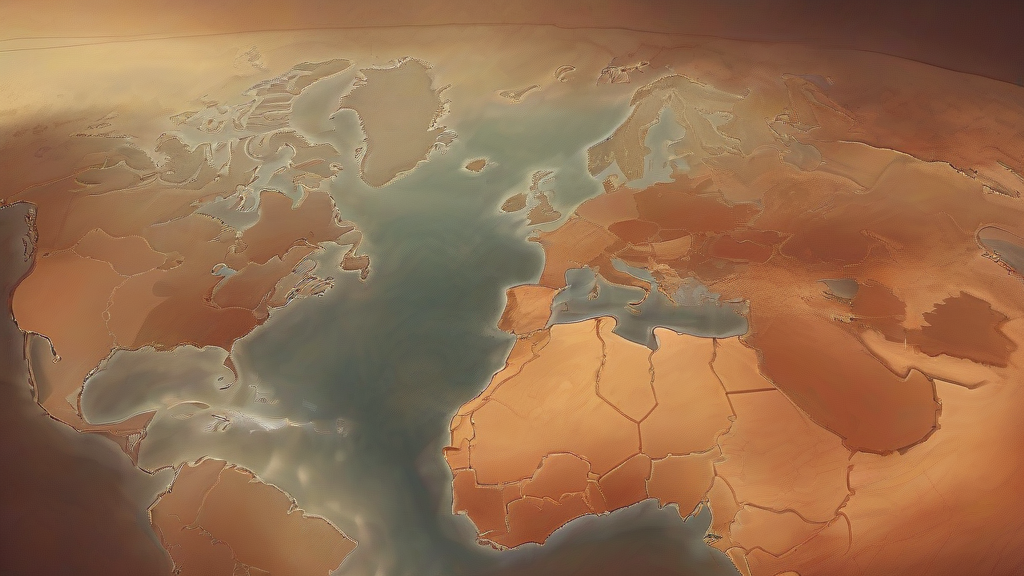
What does continent mean?
A continent is one of the Earth's principal continuous expanses of land, traditionally counted as seven: Africa, Antarctica, Asia, Australia, Europe, North America, and South America. Continents are geographical rather than political units, so a single continent may contain dozens of countries, languages, and climates. Usage varies across the English-speaking world: British speakers often use "the Continent" to mean mainland Europe, while educational traditions differ on whether Europe and Asia form one landmass (Eurasia) or whether North and South America should be treated separately. Beyond geography, the word appears in everyday phrases such as "across the continent" and "the African continent," conveying scale and reach. Its adjective form, "continental," describes things characteristic of or relating to a continent, such as continental climate or a continental breakfast. Understanding the term helps in discussing global geography, travel, and international affairs with precision.
One of the Earth's main continuous expanses of land, conventionally reckoned as Africa, Antarctica, Asia, Australia, Europe, North America, and South America.
"Antarctica is the only continent with no permanent human residents."
In British usage, "the Continent" specifically means mainland Europe, excluding the British Isles.
A very large landmass regarded collectively, especially as distinguished from islands or smaller landforms.
"The explorers spent months charting the interior of the continent."
(Now chiefly archaic or medical.) Able to control urination and defecation; self-restraining.
"The patient remained continent following the surgery."
This adjective sense survives mainly in medical contexts; the noun "continence" carries the general sense of self-restraint.
Regular plural. Commonly used when comparing or listing several landmasses, e.g. in discussions of travel, biogeography, or geology.
"Penguins are found on continents throughout the Southern Hemisphere."
The number of continents depends entirely on where you went to school — the same planet is taught as having five, six, or seven.
Reviewed by Deb Chak, Editor. AI-assisted content curated by RJS Tech Solutions LLP.
Etymology of continent
"Continent" derives from the Latin "continens" (genitive "continentis"), meaning "holding together" or "continuous," the present participle of "continere" — literally "to hold together." It entered English in the late 16th century, first used in the sense of a connected tract of land. The word shares its root with "contain," "content," "continue," and "continuous." The adjective "continental" developed alongside it, and the related noun "continence" reflects the older sense of self-restraint implied by the original Latin participle.
Related word forms
How continent is actually used
In British English, "the Continent" (always capitalized) idiomatically refers to mainland Europe as seen from Britain or Ireland. The count of continents varies by tradition: some models merge Europe and Asia into Eurasia, or combine the Americas into a single continent.
Easily confused with continent
"Continence" means self-restraint, especially control over bodily urges, while "continent" means a large landmass or, adjectivally, able to control one's bladder or bowels.
A country is a politically defined nation-state, whereas a continent is a vast geographical landmass that typically contains many countries.