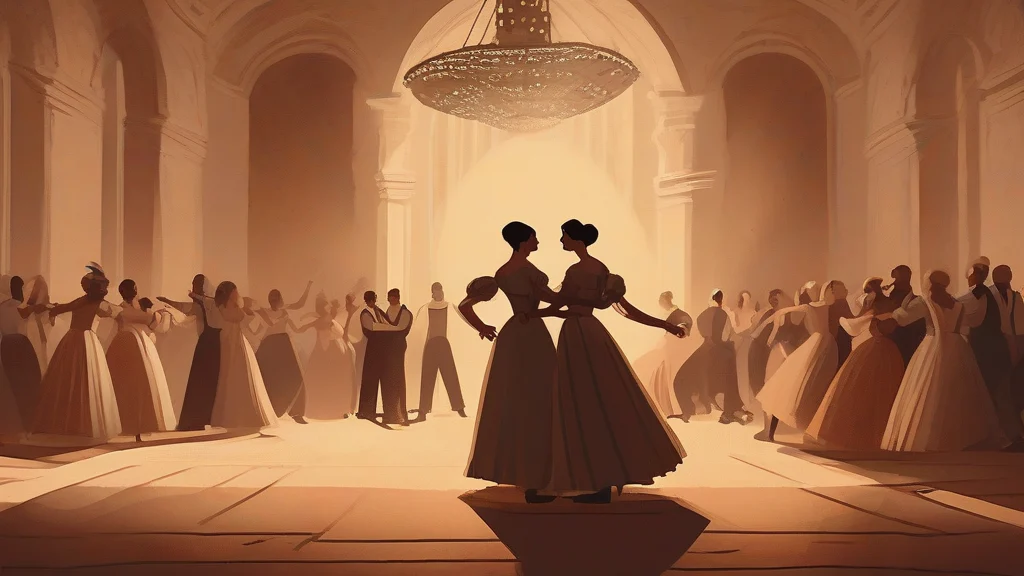
What does contredanse mean?
A contredanse is a social dance in which couples are arranged in facing lines or squares and perform a sequence of figure movements directed by a caller or by convention. Originating in France in the late 17th or early 18th century — its name deriving from the French contre, meaning opposite, with the dances themselves rooted in English country dances — the form spread across Europe and became a staple of balls throughout the 18th and 19th centuries. Composers such as Mozart and Beethoven wrote contredanse music, typically light pieces in duple meter designed for dancing rather than concert performance. Over time the contredanse gave rise to derivative forms, most notably the quadrille, and its tradition crossed the Atlantic, where it evolved into the American contra dance still danced today. The term now appears mainly in historical, musical, and folk-dance contexts, carrying an air of elegance and period charm.
nounA dance performed by rows or circles of couples facing one another, of French origin and popular throughout Europe in the 18th and 19th centuries; also the music written for such a dance.
- A social dance for couples arranged in lines or squares, performing figured movements, popular in Europe from the early 18th century onward.
- A piece of music, typically in duple meter, composed to accompany such a dance.
"The ball opened with a lively contredanse that had the entire assembly moving in long opposing lines."
"The orchestra struck up a brisk contredanse and the couples took their places in two long facing lines."
"Mozart wrote several contredanses for the court balls at Vienna."
Standard plural; commonly used when referring to multiple dances or musical pieces of the genre.
"The collection includes several contredanses composed for the imperial court."
The word 'contredanse' literally means 'opposite dance' — dancers face each other in lines, and it gave rise to everything from the quadrille to American square dancing.
Reviewed by Deb Chak, Editor. AI-assisted content curated by RJS Tech Solutions LLP.
Etymology of contredanse
The word comes from French contredanse, formed from contre ("opposite" or "facing") and danse ("dance"), referring to the arrangement of dancers in opposing lines. It entered English in the early 18th century as the French fashion for these figure dances swept European courts. Despite its name suggesting opposition, the genre itself grew largely out of English country dances adopted into French society, and the related term "contradance" appears as an anglicized variant. Its Latin-derived prefix contra links it to words such as "contrast," "contrary," and "counterpoint."
How contredanse is actually used
"Contredanse" is a somewhat formal or historical term, encountered chiefly in writing about 18th- and 19th-century music and dance. The anglicized spelling "contradance" is also found, especially in American usage referring to the modern "contra dance" tradition descended from it.
Easily confused with contredanse
Country dance is the English social dance from which the French 'contredanse' derives its name; the two terms refer to closely related but historically distinct traditions.
The quadrille is a specific square dance for four couples that evolved out of the contredanse, whereas contredanse is the broader term for line-and-figure dances of this family.