What does cookie mean?
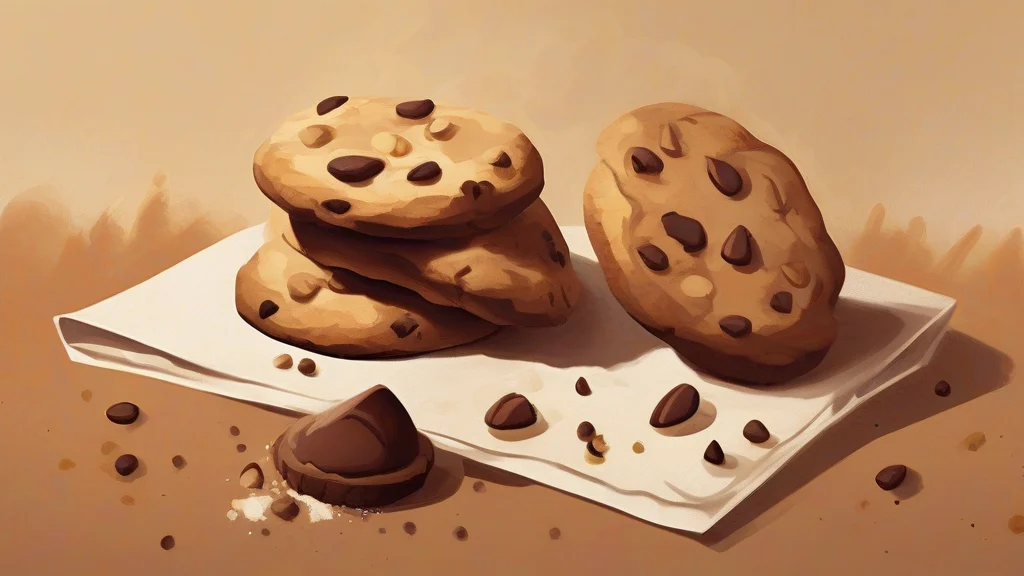
A cookie is a small, flat, sweet baked good made from a dough of flour, sugar, butter, and eggs, typically flavored with ingredients such as chocolate chips, oats, nuts, or spices, and baked until crisp or left slightly chewy. The word carries warm, homey connotations of baking, childhood, and comfort, and it appears in many well-worn idioms, including "tough cookie," "smart cookie," and "that's the way the cookie crumbles." Beyond the kitchen, cookie has taken on a distinct technical meaning: in web browsing, a cookie is a small file that a website stores on a user's device to remember preferences, logins, or activity, making the term familiar to anyone who has accepted a site's privacy notice. In British English the traditional equivalent is the biscuit, though cookie has become increasingly recognized there as well. Derived forms such as cookie cutter and cookie jar have entered everyday language in their own right, the former even used figuratively to describe anything blandly uniform.
nounA small, flat, sweet baked cake, typically crisp or chewy, made from flour, sugar, butter, and eggs, often flavored with chocolate chips, nuts, or spices; in computing, a small piece of data stored by a website in a user's browser.
- A small, sweet, flat baked treat.
- A person described as a certain type of character, as in a tough cookie or smart cookie.
- In computing, a small file a website stores on a user's device to remember information about them.
"She baked a batch of chocolate chip cookies for the school fundraiser."
"He reached into the cookie jar hoping to find one last oatmeal raisin cookie."
"The website placed a cookie in her browser so it would remember her login preferences."
Standard plural; the older variant spelling "cooky" pluralizes as "cookies" but is now largely obsolete.
"She packaged up two dozen cookies to send to her brother at college."
The word "cookie" comes from the Dutch for "little cake" — which means every time you eat one, you're technically eating a tiny cake.
Reviewed by Deb Chak, Editor. AI-assisted content curated by RJS Tech Solutions LLP.
Etymology of cookie
Cookie derives from the Dutch word "koekje," literally "little cake," a diminutive of "koek" meaning cake; Dutch settlers brought the word and the treat itself to America, where it took hold. The Dutch "koek" and English "cake" trace back to a shared Germanic root, making them distant cousins rather than direct borrowings. In Britain, where the Dutch influence did not shape everyday baking vocabulary, "biscuit" remained the standard term. The computing sense arose independently in the 1990s, borrowing the name as a whimsical metaphor for small pieces of data passed between programs.
Related word forms
How cookie is actually used
In British English, the equivalent baked good is usually called a "biscuit," though "cookie" is widely understood and increasingly common there, especially for the soft, chewy American style. The figurative sense describing a person (as in "a tough cookie") is informal but firmly established in both varieties.
Easily confused with cookie
"Cooky" is an older American variant spelling of the same word "cookie," not a separate word with a different meaning.