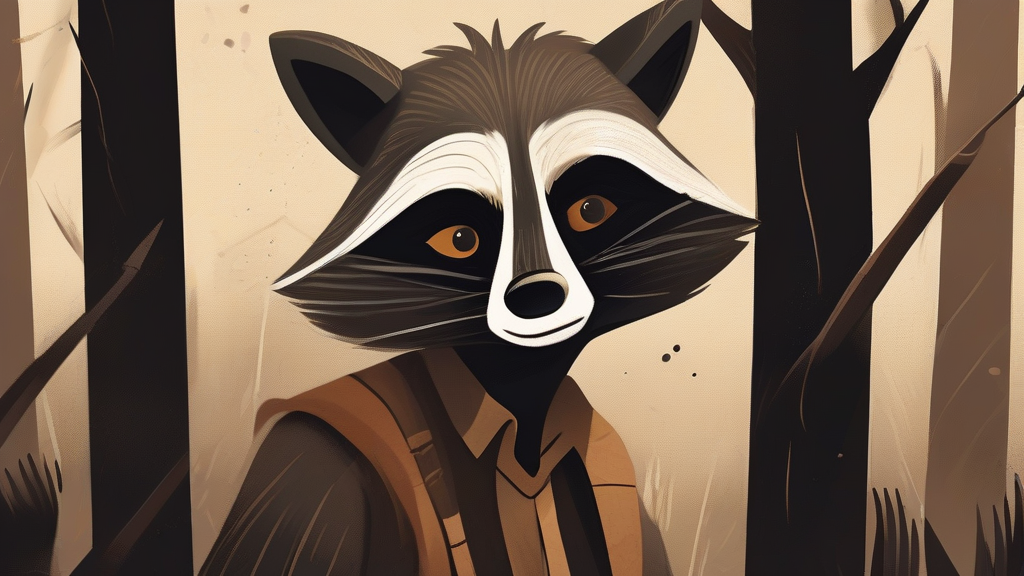
What does coon mean?
"Coon" began life as an eighteenth-century American shortening of "raccoon," itself borrowed from an Algonquian language of coastal Virginia. In that neutral sense it survives mainly in rural speech, in compounds such as "coonhound," and in the folksy idiom "a coon's age," meaning a very long time. But the word's dominant modern meaning is far darker: from roughly the mid-nineteenth century onward it was used in the United States as a contemptuous, dehumanizing slur against Black people, and it remains one of the most offensive racial epithets in English. Because the racist sense now overwhelms all others, careful writers and speakers avoid the word altogether — even when discussing the animal — preferring "raccoon" instead. It stands as a striking example of how a once-innocent term can be permanently poisoned by the history of its use.
Extremely offensive slang: a Black person.
"The word is a racist slur that has no place in civil discourse."
Never acceptable in ordinary speech or writing; listed here only for recognition.
Informal shortening of "raccoon."
"A coon had tipped over the trash cans again overnight."
Dated or regional; increasingly avoided because of the word's racist sense.
In the phrase "a coon's age": a very long time.
"I haven't been back to that town in a coon's age."
Folksy American idiom; still heard among older speakers but fading due to the slur association.
Regular plural; applies to the animal sense only.
"Coons raid the bird feeder almost every night around here."
A harmless nickname for a clever backyard animal became one of the ugliest slurs in American English — a word whose history is a lesson in how language can be weaponized.
Reviewed by Deb Chak, Editor. AI-assisted content curated by RJS Tech Solutions LLP.
Etymology of coon
"Coon" arose in early eighteenth-century America as a clipped form of "raccoon," a word English colonists borrowed from Powhatan, an Algonquian language of Virginia, in which the animal's name was something like "aroughcun." The shortened form appears in American writing from around the 1730s–40s. By the 1830s it had taken on its racist sense in the United States, likely reinforced by popular blackface songs and minstrel imagery of the era, and that usage spread widely through the nineteenth and twentieth centuries. Its only close English relative is the parent word "raccoon" itself.
Related word forms
How coon is actually used
This word must be handled with extreme care: as a racial slur it is deeply offensive and should never be used to refer to a person. Its non-slur senses (the animal, or "a coon's age") are dated, informal, or regional, and even in those innocent-seeming uses many listeners will hear the slur first, so most speakers avoid the word entirely.
Easily confused with coon
"Raccoon" is the full, neutral name of the animal, while "coon" is merely its colloquial shortening — and in most modern contexts carries a racist meaning unrelated to the animal.
"Goon" rhymes with "coon" but means a thug or foolish person, sharing no meaning with it.