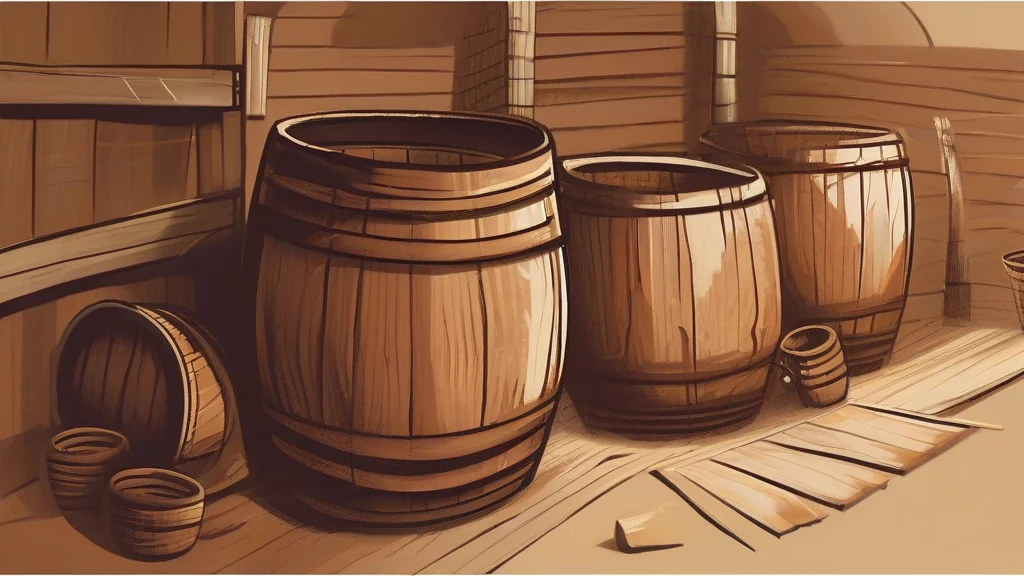
What does coopering mean?
Coopering is the craft of making and repairing wooden vessels — chiefly barrels, casks, vats, and tubs — by fitting shaped staves together and binding them with hoops, traditionally without glue or nails, relying instead on the precise bevelled edges of the wood and the pressure of iron hoops to create a watertight seal. The term names both the trade itself and, more broadly, the work performed by its practitioner, the cooper. Once an essential industry serving brewers, winemakers, distillers, merchants, and navies, coopering declined with the rise of metal and plastic containers, yet it survives as a specialised craft because oak casks remain central to ageing whisky, wine, and bourbon. Practitioners distinguish wet (tight) coopering for liquid-tight casks from dry (slack) coopering for dry-goods containers. Today the word appears mainly in contexts of heritage, distilling, and traditional trades, where it evokes meticulous hand skill and centuries of accumulated know-how.
The craft or trade of making and repairing wooden casks, barrels, vats, and other staved vessels bound with hoops.
"Traditional coopering survives at only a handful of workshops in Britain."
Often used in the compounds 'wet coopering' (liquid-tight vessels) and 'dry coopering' (dry-goods vessels).
To carry out the work of a cooper; to make or repair barrels, casks, or similar wooden vessels.
"For thirty years he coopered barrels for the local brewery."
Rarely used outside trade or historical writing.
As the name of a craft or activity, 'coopering' is normally uncountable; a plural such as 'cooperings' would be highly unusual.
"Coopering was once among the most widespread of all skilled trades."
Every oak barrel holding whisky, wine, or bourbon still owes its existence to coopering — one of humanity's oldest precision crafts, perfected over two thousand years without nails or glue.
Reviewed by Deb Chak, Editor. AI-assisted content curated by RJS Tech Solutions LLP.
Etymology of coopering
The word cooper comes from Middle Dutch or Middle Low German 'cuper' or 'kuper', meaning a maker of tubs and casks, which was borrowed into English during the medieval period. The Germanic term itself is generally connected to Latin 'cupa', meaning a vat or tub, the same source that gave English the word 'cup'. Coopering is simply the derived form naming the trade's activity, while 'coopery', a workshop or premises where such work is done, belongs to the same family of terms.
Related word forms
How coopering is actually used
Coopering is largely a technical and historical term today, encountered most often in writing about trades, brewing, distilling, maritime history, and heritage crafts. Within the trade it is subdivided: 'wet' (or tight) coopering produces liquid-tight vessels such as barrels and casks, while 'dry' (or slack) coopering covers containers for dry goods such as buckets, churns, and tubs. The word carries connotations of skilled manual craftsmanship rather than everyday use.
Easily confused with coopering
Cooping means confining someone against their will in a small space (historically used in electoral fraud), whereas coopering refers solely to the trade of making wooden barrels and casks.