What does coot mean?
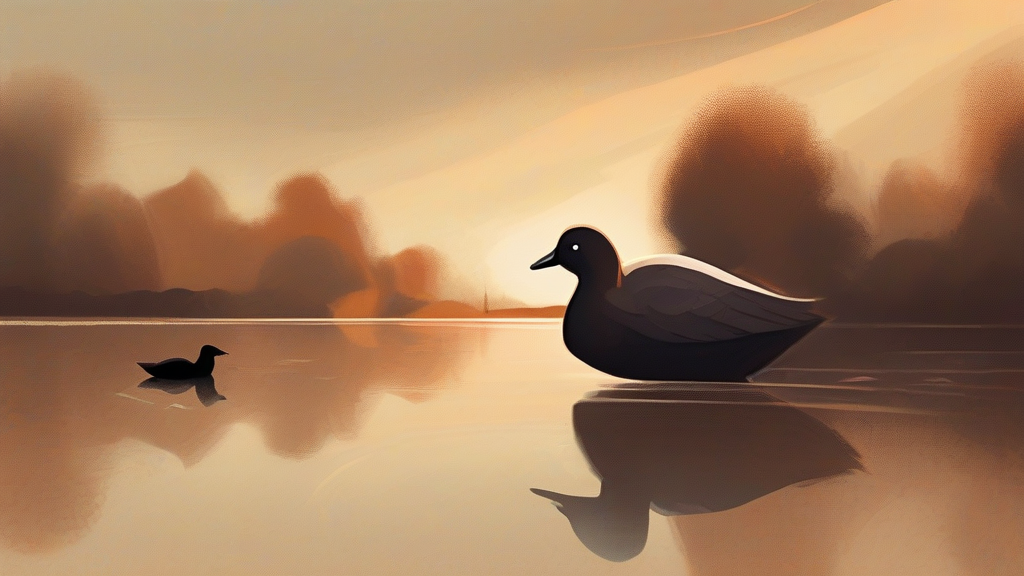
A coot is first and foremost a waterbird belonging to the rail family, genus Fulica, familiar across Europe and North America. It is plump and dark-feathered, with a striking white bill and a matching plate, called a frontal shield, extending up onto its forehead. Coots are common on lakes, ponds, and slow rivers, where they dive for vegetation and squabble noisily over territory. Beyond ornithology, 'coot' has long served in informal speech as a gently mocking label for an elderly man seen as foolish, stubborn, or endearingly eccentric, giving rise to phrases such as 'old coot' and 'crazy old coot'. The best-known expression, 'bald as a coot', is delightfully ironic, since the bird is fully feathered and only appears bald-faced thanks to its white shield. The word thus bridges field guides and everyday banter, useful to birdwatchers and humorists alike.
An aquatic bird of the rail family (genus Fulica), having dark plumage and a white bill and frontal shield.
"A pair of coots nested among the reeds at the edge of the pond."
Standard in British and American usage; the Eurasian coot (Fulica atra) and American coot (Fulica americana) are the species most commonly meant.
(Informal) An elderly person, especially a man, regarded as foolish, eccentric, or mildly senile.
"The neighbours dismissed him as a crazy old coot, though his complaints were usually justified."
Informal register; usually affectionate teasing but potentially offensive if used dismissively.
Regular plural; flocks of coots are simply referred to as 'coots', sometimes described collectively as a 'raft' when floating together on water.
"Hundreds of coots winter on the lake each year."
'Bald as a coot' is one of English's most misleading idioms — the coot is famously covered head-to-toe in feathers; only its white face patch looks bare.
Reviewed by Deb Chak, Editor. AI-assisted content curated by RJS Tech Solutions LLP.
Etymology of coot
The word 'coot' comes through Middle English, where it was recorded by the fourteenth century, and its ultimate origin is uncertain, though it has often been compared with Middle Dutch 'koete', the name for the same bird, suggesting a Low Countries connection. The figurative sense of an eccentric or foolish old man developed later, likely because coots were traditionally regarded as dim-witted birds, easy to catch and seemingly clumsy on land. The idiom 'bald as a coot' dates back several centuries and survives as one of the word's most familiar appearances, even though it misdescribes the bird's plumage.
How coot is actually used
The figurative sense is informal and chiefly applied to older men; it can be affectionately teasing or mildly derogatory depending on tone. The phrase 'bald as a coot' is widespread in British and American English despite being ornithologically inaccurate. The bird sense is standard in both naturalist writing and casual speech.
Easily confused with coot
A cootie (from the same bird-derived slang family) refers to a louse or germ in children's slang, while a coot is either the aquatic bird or an eccentric old man.
A coat is a garment worn on the body, whereas coot names a waterbird or, informally, an eccentric elderly person — they differ only in spelling.