What does copra mean?
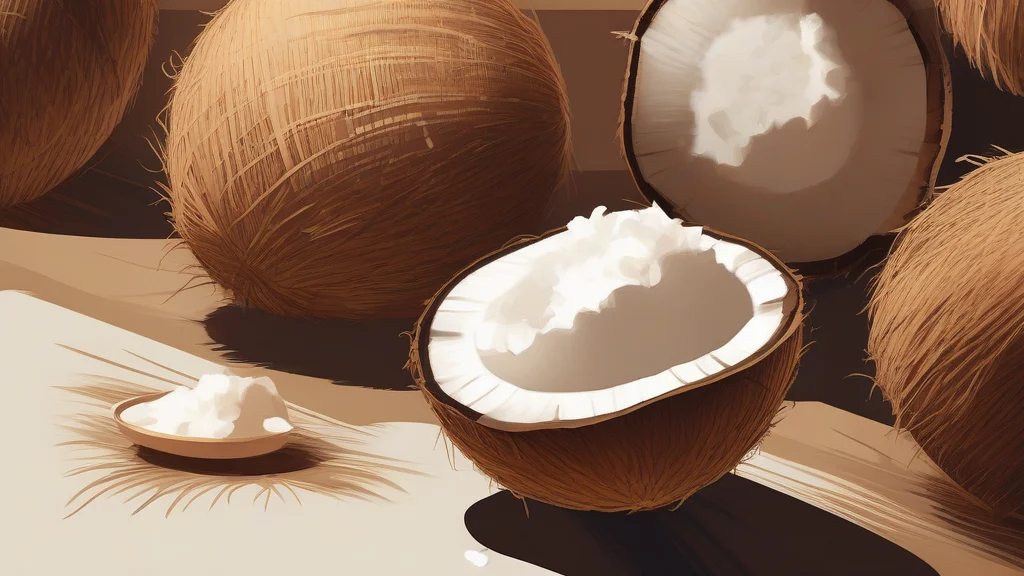
Copra is the dried kernel, or flesh, of the coconut, produced by splitting coconuts and drying them in the sun or in kilns until the moisture content drops low enough for long storage and transport. Its primary commercial importance lies as the raw material for coconut oil: the dried kernels are crushed or pressed to yield oil, leaving behind copra meal (also called copra cake), which is widely used as animal feed. The word entered European languages through Portuguese traders in southern India during the seventeenth century and remains central to the vocabulary of tropical agriculture and commodity markets. Copra trading has historically underpinned the economies of many Pacific islands, the Philippines, Indonesia, and coastal India and Sri Lanka, where coconut cultivation dominates. Though rarely heard outside farming, trade, or food-industry contexts, the term is indispensable for anyone reading about tropical commodities, and its name offers a small window into the centuries-old exchange between South Asian producers and European merchants.
nounCopra is the dried white flesh or kernel of the coconut, from which coconut oil and coconut meal are extracted.
- The dried meat or kernel of the coconut, prepared by drying either sun-dried or kiln-dried, and used chiefly as a raw material for extracting coconut oil.
"The islanders spread copra out to dry before shipping it to the oil mill."
"After the monsoon harvest, farmers laid the split coconuts on racks to dry into copra."
"World prices for copra fell sharply, squeezing the incomes of smallholder coconut growers across Southeast Asia and the Pacific."
Because copra denotes a substance rather than discrete countable objects, it has no plural form. Quantities are expressed in units such as tons or kilograms.
"The mill processed three hundred tons of copra last month."
That jar of coconut oil in your kitchen almost certainly started life as copra — the humble dried coconut flesh that fueled a global trade industry for centuries.
Reviewed by Deb Chak, Editor. AI-assisted content curated by RJS Tech Solutions LLP.
Etymology of copra
Copra was adopted into European languages from Portuguese, which took the word from southern Indian sources — specifically the Malayalam word 'koppar(a)' used along the Malabar coast. English usage dates from the early seventeenth century, when Portuguese colonial trade first brought large quantities of dried coconut kernel to European markets. The term thus belongs to the family of commodity words that English absorbed through Iberian maritime commerce in Asia.
How copra is actually used
Copra is a mass noun with no plural in ordinary usage; treat it like 'flour' or 'tobacco'. It appears mainly in agricultural, economic, and historical writing about tropical economies rather than everyday conversation, and carries no strong connotations — it is a neutral technical term.
Easily confused with copra
Copper is a reddish metallic element, whereas copra is the dried kernel of the coconut used to produce oil.