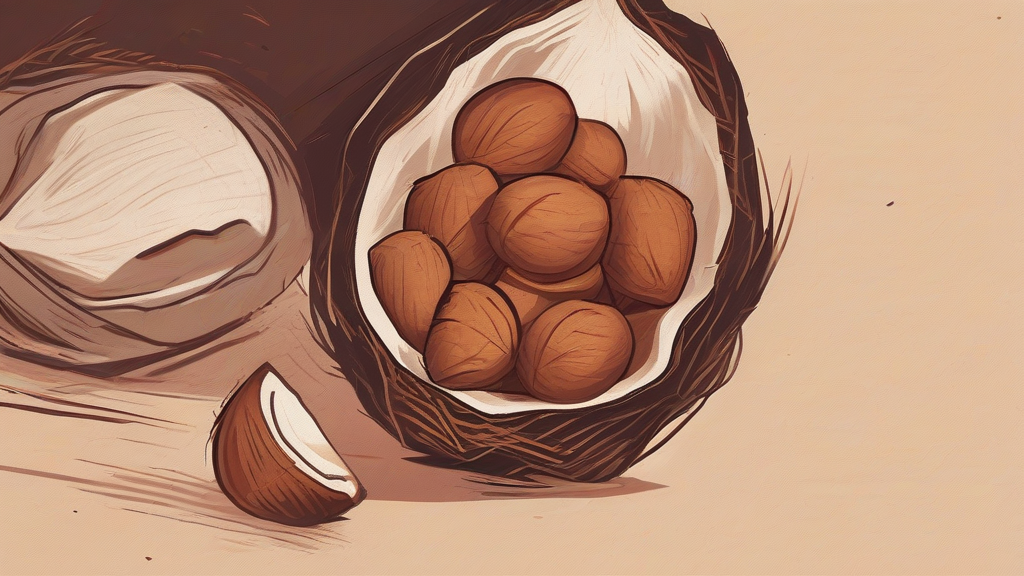
What does coprah mean?
Coprah is a variant spelling of "copra," referring to the dried kernel or flesh of the coconut. Once coconuts are harvested, they are split open and their white flesh is removed and dried — either in the sun, in kilns, or over smoke — producing coprah. This dried material is then transported to mills where it is crushed or pressed to extract coconut oil, a commodity used in cooking, soap-making, cosmetics, and margarine. What remains after pressing is known as copra meal or copra cake, which serves as protein-rich livestock feed. Coprah has historically been central to the economies of tropical regions such as the Philippines, India, Sri Lanka, Indonesia, and various Pacific islands, where it was long one of the most valuable export commodities. While the term appears mostly in commercial and agricultural writing, the more common spelling in contemporary English is simply "copra," making coprah primarily a variant encountered in older texts or certain regional publications.
nounThe dried kernel of the coconut, from which coconut oil is extracted; also spelled "copra."
- The dried flesh or kernel of the coconut, used as a source of coconut oil and as animal feed after oil extraction (in the form of copra meal).
"After the coconuts were split and sun-dried, the coprah was shipped to the mill for pressing."
"The island's economy depended heavily on the coprah trade during the colonial era."
"Farmers spread the fresh coconut halves on concrete drying floors until the coprah reached the right moisture content for milling."
Coprah functions almost exclusively as a mass noun, so a plural form is rarely needed; quantities are expressed as tons or bags rather than counted individually.
"Several tons of coprah were unloaded at the harbor."
Before your coconut oil ever touches a pan, it starts life as coprah — sun-baked coconut halves that once fueled entire island economies.
Reviewed by Deb Chak, Editor. AI-assisted content curated by RJS Tech Solutions LLP.
Etymology of coprah
The word entered English in the 17th century from Portuguese, which borrowed it from Malayalam "koppara" (or related Indic forms such as Hindi "khoprā"), meaning the dried coconut kernel. Portuguese traders encountering coconut processing along the Malabar coast carried both the product and its name into European commerce, and English adopted it as "copra," with "coprah" arising as a spelling variant reflecting the original pronunciation.
How coprah is actually used
Coprah is chiefly a variant spelling of the more standard English word "copra," which is far more common in modern usage. The term belongs mainly to commercial, agricultural, and historical contexts — particularly in discussions of tropical economies, coconut cultivation, and oil production — rather than everyday conversation. It carries no strong connotation beyond its industrial association.
Easily confused with coprah
Copper is a reddish metallic element, while coprah (or copra) is the dried kernel of the coconut used to produce oil.