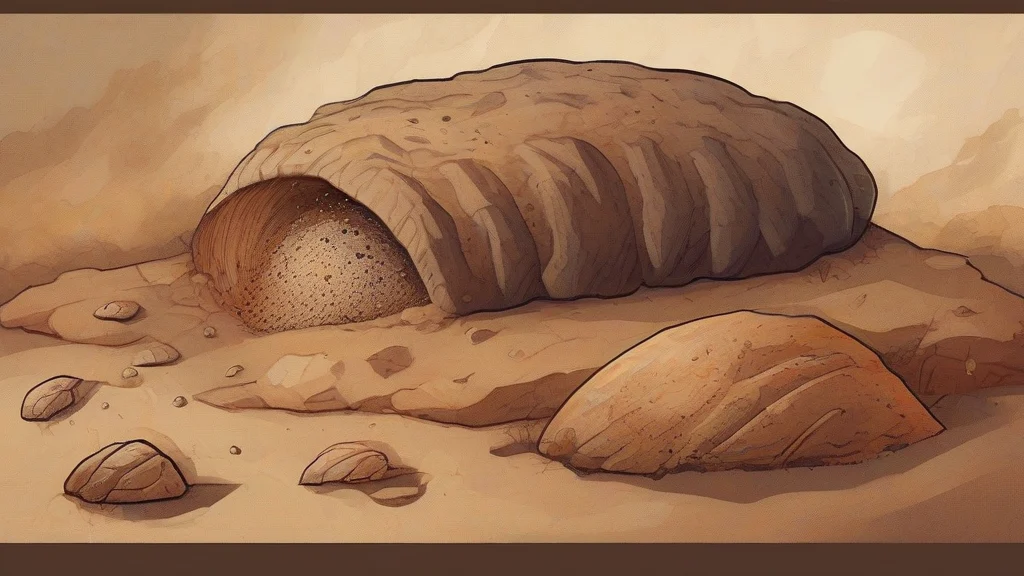
What does coprolite mean?
A coprolite is the fossilized excrement of an ancient organism — most famously dinosaurs, sharks, crocodiles, and other prehistoric animals. The word derives from Greek roots meaning 'dung' and 'stone,' reflecting exactly what a coprolite is: dung turned to rock over millions of years through mineralization. Far from being a curiosity or a joke, coprolites are scientifically valuable: because they preserve undigested food fragments, pollen, parasites, and other traces, they offer direct evidence of an extinct animal's diet, health, and environment that bones alone cannot provide. Paleontologists analyze their contents microscopically to reconstruct ancient ecosystems. Coprolites also have a human history: in the 1840s, phosphate-rich nodules found in England were mistaken initially for fossils but quickly became a major fertilizer industry. Though strictly a technical term confined largely to scientific literature, coprolite is memorable precisely because it turns something unglamorous into one of paleontology's most informative records.
nounA coprolite is fossilized animal dung, especially that of prehistoric creatures, valued by paleontologists for the dietary and environmental information it preserves.
- Fossilized excrement of an ancient animal, studied in paleontology.
- Mineralized nodular masses formerly mined in England as a source of phosphate fertilizer.
"The paleontologists carefully catalogued each coprolite recovered from the Cretaceous dig site, hoping to reconstruct the dinosaur's last meals."
"Analysis of a Tyrannosaurus rex coprolite revealed crushed bone fragments, confirming its bone-crushing bite."
"In nineteenth-century Suffolk, coprolites dug from the chalk were ground up and sold as fertilizer."
Standard plural; often used when discussing multiple specimens from a dig site.
"Dozens of fish coprolites were recovered from the Jurassic shale beds."
Some of the best-preserved dinosaur 'poop' ever found sold at auction for thousands of dollars — coprolites are fossils you can literally read a prehistoric animal's menu from.
Reviewed by Deb Chak, Editor. AI-assisted content curated by RJS Tech Solutions LLP.
Etymology of coprolite
The word 'coprolite' was coined in the early nineteenth century from Greek roots: 'kopros' (κόπρος), meaning dung, combined with 'lithos' (λίθος), meaning stone — literally 'dung stone.' It was introduced around 1829–1836 by the English geologist William Buckland, who recognized certain spiral fossil masses as petrified feces of extinct reptiles. The same Greek root gives rise to related terms such as coprophagy (eating dung) and coprology (the study of feces).
Related word forms
How coprolite is actually used
Coprolite is a technical term used mainly in paleontology and geology; it carries no everyday connotation beyond its scientific meaning. It is occasionally encountered in historical contexts referring to the 19th-century phosphate mining industry.
Easily confused with coprolite
Coprolalia is the involuntary utterance of obscene words (a symptom of some tic disorders), whereas coprolite is fossilized dung.