What does coral mean?
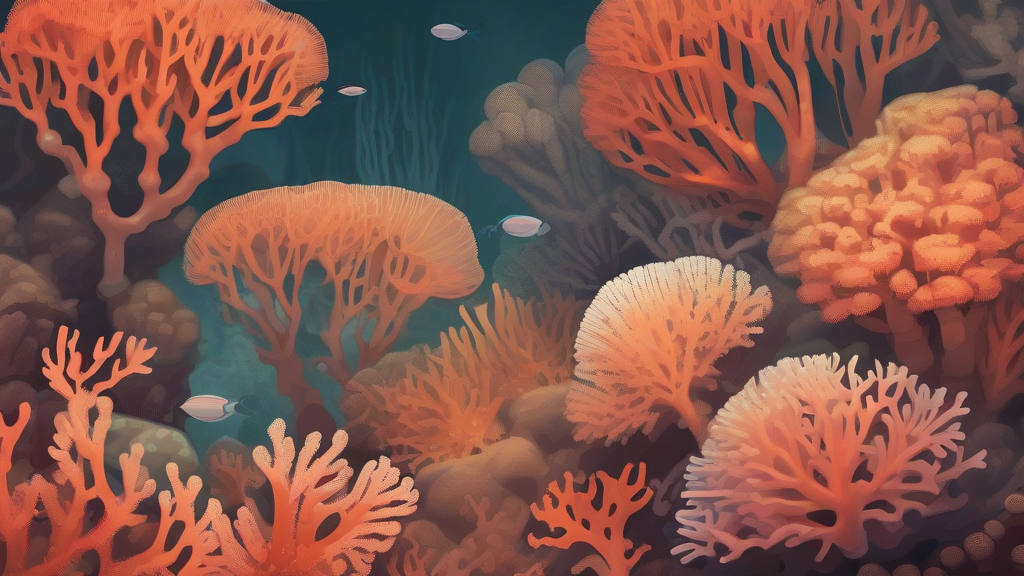
Coral is the hard, stony material produced by colonies of tiny marine animals known as coral polyps, which secrete calcium carbonate skeletons that accumulate over time into vast underwater structures called coral reefs. These reefs are among the most biodiverse ecosystems on Earth, supporting enormous numbers of fish and other sea creatures. The word also names a warm pinkish-red or orange-red colour, widely used in fashion and design, derived from the appearance of precious red coral once prized in jewellery. In everyday English, "coral" appears most often in phrases such as "coral reef," "coral bleaching," and "coral snake." It functions primarily as a noun, though it frequently serves attributively as a modifier. Because coral reefs face serious threats from warming seas and pollution, the word now carries strong environmental connotations, evoking both natural beauty and ecological fragility.
A hard stony substance made up of the skeletons of marine polyps, forming reefs; also a pinkish-red colour.
"The snorkellers drifted above beds of coral alive with tropical fish."
Usually uncountable for the material; countable for individual colonies or pieces.
Of a pinkish-red or orange-red colour like that of coral.
"He painted the front door a cheerful coral shade."
The plural "corals" refers to individual colonies, species, or pieces of coral rather than the material as a mass noun.
"Scientists catalogued dozens of different corals along the reef wall."
Coral isn't a plant or a rock — it's built by tiny animals, and the Great Barrier Reef they've constructed is visible from space.
Reviewed by Deb Chak, Editor. AI-assisted content curated by RJS Tech Solutions LLP.
Etymology of coral
The word "coral" entered Middle English from Old French "corail," which itself derives from Latin "corallium," borrowed from Greek "korallion." The ultimate origin may lie further back, possibly via Semitic languages, though this is uncertain. The colour sense developed later, by association with the hue of red coral used ornamentally since antiquity.
Related word forms
How coral is actually used
As a noun, "coral" is usually uncountable when referring to the material but can be countable when referring to an individual colony or piece. As a colour term it often appears attributively (e.g., "a coral blouse").
Easily confused with coral
"Choral" relates to a choir or choral singing, while "coral" is the hard marine substance or its colour.