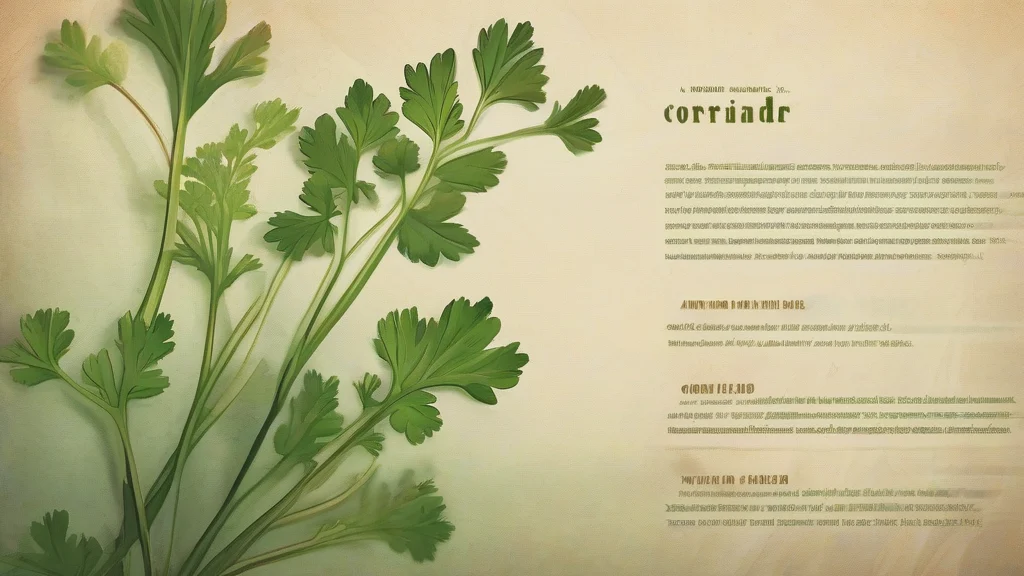
What does coriander mean?
Coriander is an annual herb of the parsley family, prized across world cuisines for two distinct harvests: its bright, feathery green leaves and its small round dried fruits, sold whole or ground as a spice. The leaves lend a fresh, citrus-parsley note to salsas, curries, chutneys, and salads, while the seeds offer a warmer, nuttier flavour that suits breads, pickles, spice blends such as garam masala, and braised dishes. Usage varies sharply by region: British and Commonwealth cooks call the fresh herb 'coriander', whereas Americans call it 'cilantro' and reserve 'coriander' for the seed. The word also carries a famous quirk — a significant share of people carry a genetic variant that makes the leaves taste unpleasantly soapy, making coriender one of the most polarising ingredients in the kitchen. Beyond cooking, it has a long history as a medicinal and aromatic plant, appearing in ancient records from the Mediterranean and South Asia alike.
An aromatic annual herb (Coriandrum sativum) of the parsley family, native to regions spanning southern Europe, North Africa, and southwestern Asia, grown for its fresh leaves and its dried seedlike fruits.
"Coriander grows quickly in cool weather and goes to seed readily in summer heat."
When referring to the whole plant or fresh leaves, the word is treated as uncountable.
The dried fruit (seed) of this plant, used whole or ground as a spice with a mild, warm, citrusy flavour.
"Add a teaspoon of ground coriander to the marinade for extra depth."
This sense dominates American usage, where the fresh herb is called cilantro instead.
As a culinary ingredient, coriander is normally used as an uncountable mass noun; a plural form appears only in limited technical or commercial contexts.
"The recipe calls for two tablespoons of chopped coriander."
Coriander and cilantro are the very same plant — and for roughly one in five people, genetics makes those leaves taste distinctly like soap.
Reviewed by Deb Chak, Editor. AI-assisted content curated by RJS Tech Solutions LLP.
Etymology of coriander
Coriander derives from the Latin 'coriandrum', which was borrowed from the ancient Greek 'koriannon' (also spelled 'koriandron'); the ultimate origin of the Greek word is uncertain, though some suggest a connection to 'koris', meaning bedbug, a nod to the plant's pungent smell. The name entered Old French as 'coriandre' and passed into Middle English during the medieval period, appearing in English herbals and cookery texts by the fourteenth century. The Latin root also survives directly in Romance languages, giving modern French 'coriandre', Spanish 'culantro/coriandro', and Italian 'coriandolo'.
How coriander is actually used
In British and Commonwealth English, 'coriander' typically means the fresh leafy herb; in American English the same herb is called 'cilantro', reserving 'coriander' for the seeds. In South Asian cooking the word (often 'dhania') covers both parts of the plant. The word is uncountable when referring to the herb or ground spice, but may take a plural ('corianders') only rarely, e.g. for individual seeds in botanical contexts.
Easily confused with coriander
Cilantro and coriander come from the same plant: in American usage 'cilantro' refers to the fresh leaves while 'coriander' usually refers to the dried seeds.
Caraway seeds look similar to coriander seeds and are also used as a spice, but caraway has a sharp, anise-like flavour while coriander is citrusy and milder.