
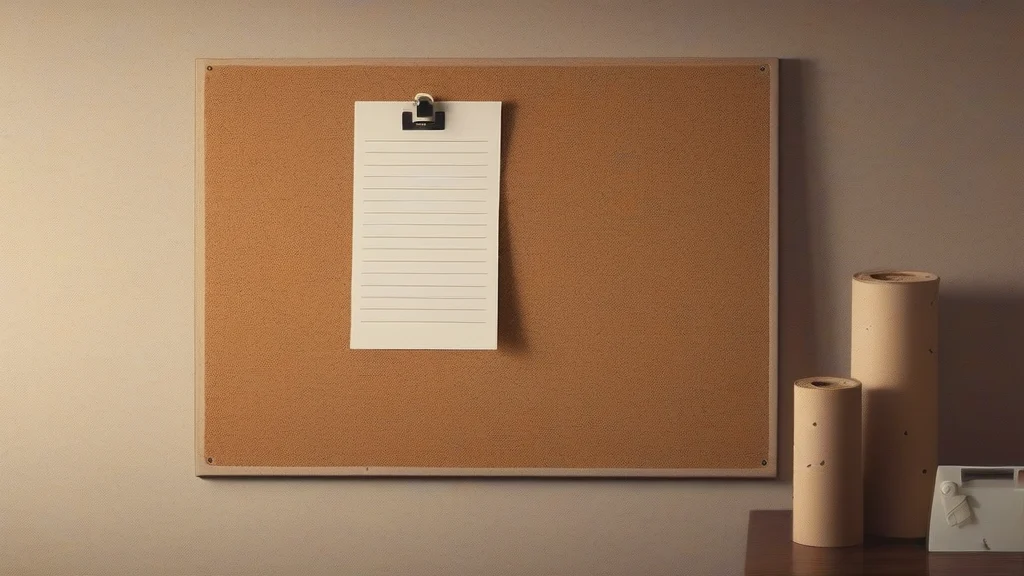
What does corkboard mean?
A corkboard is a display board manufactured by compressing small granules of cork — the spongy bark harvested from the cork oak tree — into a flat, dense panel. Its natural softness allows papers, photographs, reminders, and mementos to be attached with pushpins without damage to either the items or the board itself, which can absorb countless pinholes and still hold fast. Corkboards appear almost everywhere people need to share information informally: kitchens, classrooms, dorm rooms, offices, theaters, and studios. They carry a distinctly practical, slightly nostalgic connotation, evoking handwritten notes, community announcements, and mood boards in an era increasingly dominated by digital screens. The word is straightforward English, formed transparently from 'cork' plus 'board', and is understood identically in both Britain and the United States. Simple as it is, the corkboard remains one of the most enduring low-tech tools for organizing thought and communication.
nounA lightweight board made of compressed granules of cork, typically mounted on a wall and used for pinning up notes, notices, and photographs.
- A wall-mounted board of compressed cork used for displaying notes, notices, and pictures by pinning.
"She pinned the rehearsal schedule to the corkboard beside the kitchen door."
"The teacher decorated the classroom corkboard with student artwork and upcoming assignment deadlines."
"Every audition notice in the theater district seemed to end up on some cramped backstage corkboard."
Standard plural formation; corkboard is a countable noun.
"The office manager ordered six new corkboards for the department's shared walls."
The humble corkboard owes its existence to the bark of the cork oak — the same tree that seals your wine bottles also holds up your grocery list.
Reviewed by Deb Chak, Editor. AI-assisted content curated by RJS Tech Solutions LLP.
Etymology of corkboard
Corkboard is a transparent English compound of 'cork' and 'board'. The word 'cork' entered Middle English in the medieval period, borrowed from Spanish or Portuguese 'alcorcho'/'cortica' lineage ultimately tied to the bark of the cork oak, Quercus suber, native to southwestern Europe and North Africa. The compound itself arose once manufactured cork panels became commercially available, likely in the nineteenth century, when pressed cork found widespread industrial and household uses.
How corkboard is actually used
Corkboard is an everyday, unmarked term with neutral connotation, common in domestic, office, school, and studio contexts. In British English it is sometimes written 'cork board', though 'corkboard' as a single word is standard in American usage.
Easily confused with corkboard
A bulletin board is any surface for posting notices and may be made of wood, metal, or fabric, whereas a corkboard specifically refers to one made of cork.
A whiteboard is a glossy erasable surface for writing with dry-erase markers, while a corkboard is a soft cork surface meant for pinning items rather than writing on.