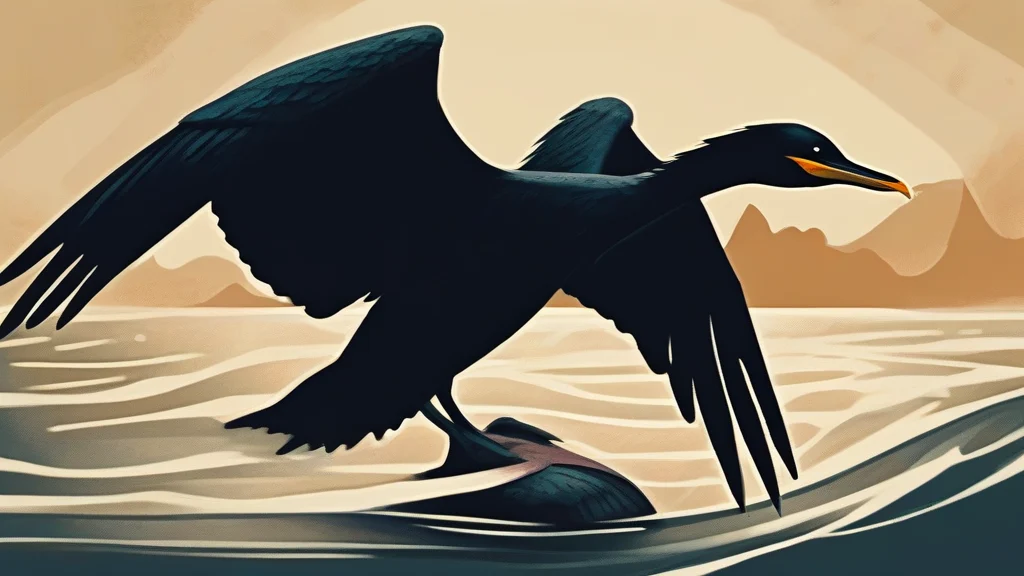
What does cormorant mean?
A cormorant is a large aquatic bird belonging to the family Phalacrocoracidae, found on coasts, rivers and lakes across much of the world. It has dark plumage, a long neck, a hooked bill, and webbed feet set far back on its body — features suited to pursuit-diving for fish. Unlike many waterbirds, cormorants lack fully waterproof feathers; they swim low in the water with only the head and neck visible, then perch upright with wings spread wide to dry. Because they eat large quantities of fish, they have historically been regarded as competitors by anglers, and this reputation gave rise to a figurative sense: from at least Shakespearean times, 'cormorant' described a greedily rapacious person, a usage still encountered in literature. Familiar species include the great cormorant of Eurasia and the double-crested cormorant of North America. For readers, the word is chiefly useful as a precise ornithological term, but knowing its figurative history enriches encounters with classic English prose.
nounA large, long-necked diving seabird of the family Phalacrocoracidae, with dark plumage, a hooked bill, and the habit of swimming low in the water with its back exposed. The word is also used figuratively for a greedy or rapacious person.
- A large fish-eating seabird of the family Phalacrocoracidae that swims low in the water and dries its wings outstretched.
- (Figurative, now chiefly literary) A greedily grasping or rapacious person.
"Cormorants perched along the harbour wall, spreading their wings to dry."
"Cormorants perched along the harbour wall, spreading their wings to dry after fishing."
"Critics portrayed the landlord as a cormorant who devoured the savings of his tenants."
Standard regular plural; used both literally (for multiple birds) and, rarely, figuratively.
"Hundreds of cormorants winter along the coast here."
Cormorants were so notorious for devouring fish that medieval English used 'cormorant' as an insult for anyone insatiably greedy — and Shakespeare called one of his characters 'this cormorant'.
Reviewed by Deb Chak, Editor. AI-assisted content curated by RJS Tech Solutions LLP.
Etymology of cormorant
The word 'cormorant' entered English in the Middle Ages, probably via Old French 'cormaran(t)'. Its first element is generally explained as 'corbeau'-related — i.e., from Latin 'corvus', meaning raven — reflecting the bird's black plumage, while the second element may reflect a Germanic or French word meaning 'to gulp' or a sea-related root; the exact composition is debated among etymologists, so only the broad outline is certain. The figurative sense of a rapacious, greedy person arose in Elizabethan English, appearing prominently in writers such as Shakespeare and Milton.
How cormorant is actually used
Primarily a naturalist's and birdwatcher's term; it is neutral in register when referring to the bird. The figurative sense ('greedy person') is now largely literary or historical, though it survives in older writing.
Easily confused with cormorant
The shag is a smaller, slimmer relative of the cormorant with a crest and greener sheen; 'shag' is also unrelatedly a term for coarse hair or a carpet pile.
Though both are diving waterbirds and 'loot' appears in some older texts as a synonym for cormorant, 'loot' is today primarily a word for plundered goods.