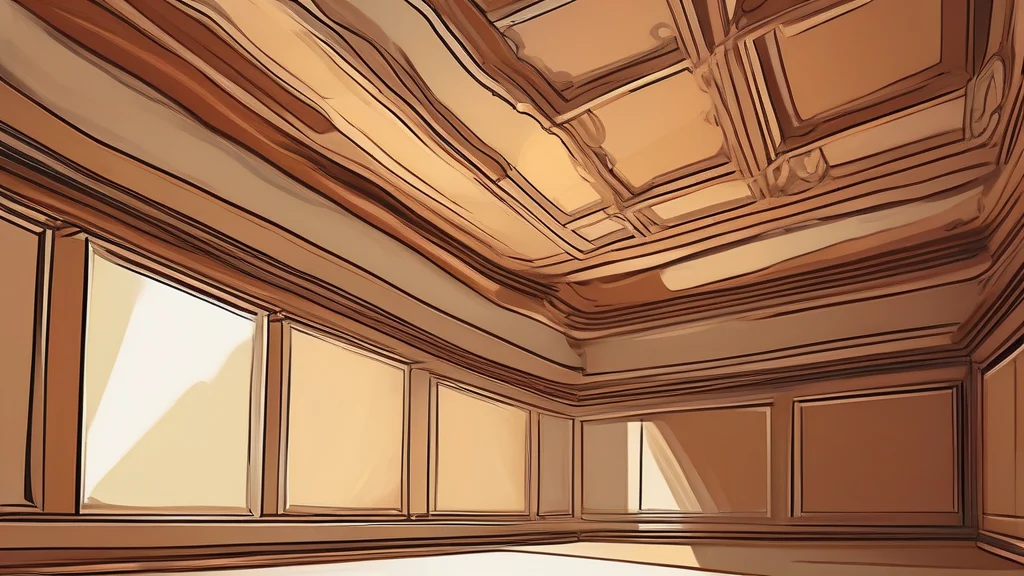
What does cornicing mean?
Cornicing refers to the decorative moulding that crowns an interior wall where it meets the ceiling, softening the junction between the two surfaces and lending rooms a sense of finish and grandeur. The word also describes the craft or material involved in producing this feature. Cornicing ranges from simple, restrained curves to elaborate classical designs incorporating dentils, egg-and-dart motifs, and deep plaster projections, and it is especially prized in Georgian, Victorian, and Edwardian buildings. In property contexts, intact or sympathetically restored cornicing is often cited as a marker of period character and can add value to a home. The term is chiefly British; American speakers more often say 'cornice' for the moulding itself. Because it is usually treated as an uncountable noun, speakers refer to 'some' or 'the' cornicing rather than plural forms, and it appears most frequently in architectural, interior design, and renovation writing.
nounOrnamental moulding that runs along the top of a wall where it meets the ceiling, or the material and workmanship used to create such a feature; a gerundive form referring to the act of fitting cornices.
- Decorative moulding at the junction of a wall and ceiling.
- The trade activity or material involved in installing such moulding.
"The Victorian townhouse still retained its original cornicing in the front reception rooms."
"The restoration team carefully repaired the cracked cornicing above the ballroom's windows."
"They spent weeks plastering and finishing the cornicing throughout the ground floor."
That elegant curve where your walls kiss the ceiling has a name — and in period homes, original cornicing can add thousands to a property's value.
Reviewed by Deb Chak, Editor. AI-assisted content curated by RJS Tech Solutions LLP.
Etymology of cornicing
Cornicing derives from 'cornice', which entered English from French in the mid-sixteenth century and traces back through Italian 'cornicione' ('large ledge') to Latin 'cornix', meaning crow — the projecting ledge was likened to a crow's beak or perch. The suffix '-ing' forms a noun denoting the material or workmanship of a thing, as in 'panelling' or 'cladding'. Cognates of the root appear in architectural vocabulary across Romance languages, including Italian 'cornicione' and French 'corniche'.
Related word forms
How cornicing is actually used
Primarily British usage; in American English the singular 'cornice' is more common for the moulding itself. Typically treated as an uncountable noun when referring to the feature or material.
Easily confused with cornicing
Skirting is the moulding fitted along the bottom of a wall where it meets the floor, whereas cornicing runs along the top of the wall at the junction with the ceiling.