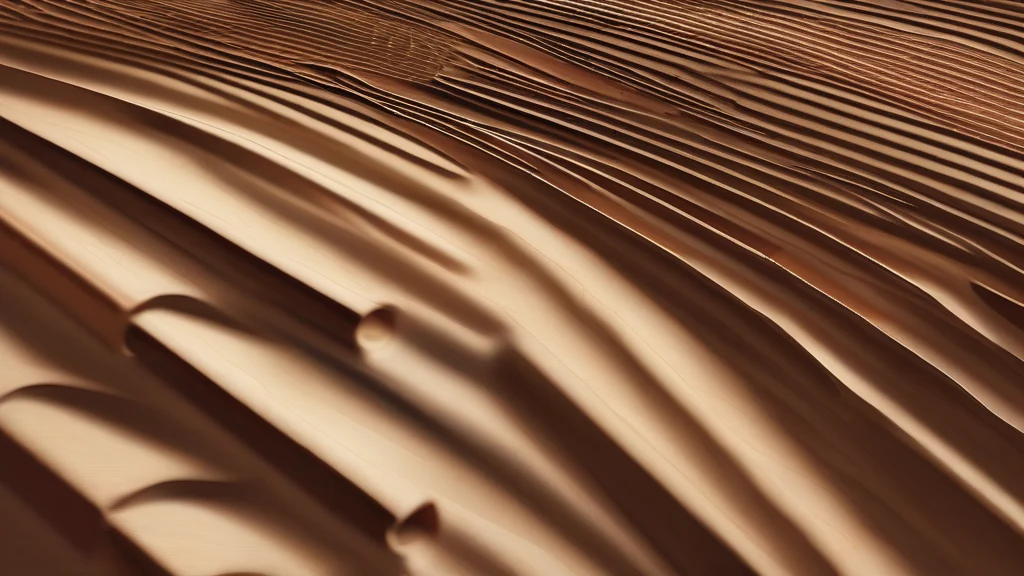
What does corrugated mean?
'Corrugated' describes something shaped into a regular series of parallel ridges and grooves, like the fluted waves running through a sheet of cardboard or the profile of corrugated iron roofing. The ridged structure is not decorative: it dramatically increases stiffness and strength without adding weight, which is why corrugated cardboard has become one of the world's most widely used packaging materials. The word derives from the Latin 'corrugare', meaning 'to wrinkle', formed from 'com-' (together) and 'ruga' (a wrinkle). While its dominant modern use is technical — applied to metal, plastic, and paper products — it can also describe surfaces marked with wrinkles or creases, such as a corrugated brow. Familiar, functional, and quietly ingenious, 'corrugated' names one of engineering's simplest and most enduring tricks: folding a flat surface to make it far stronger than it appears.
Formed into a regular pattern of parallel ridges and grooves, typically to add strength or rigidity; also, marked with wrinkles or creases.
"The farmhouse had a roof of rusting corrugated iron."
Most frequently found attributively before a noun naming the material, as in 'corrugated cardboard' or 'corrugated steel'.
Past tense and past participle of 'corrugate': to shape something into ridges and grooves, or to become so shaped.
"The machine corrugated the sheets of metal before they were galvanized."
The simple form 'corrugate' is uncommon in everyday use; the adjective sense dominates.
Before it ever carried your online orders, corrugated paper lined the sweatbands of Victorian top hats — its packaging career didn't start until decades later.
Reviewed by Deb Chak, Editor. AI-assisted content curated by RJS Tech Solutions LLP.
Etymology of corrugated
'Corrugated' comes from the Latin verb 'corrugare', meaning 'to wrinkle or fold together', a combination of 'com-' (an intensive prefix) and 'ruga' ('a wrinkle'). The word entered English in the early seventeenth century, initially describing wrinkled or furrowed surfaces. Its modern prominence grew in the nineteenth century with industrial applications, notably corrugated iron and later corrugated cardboard. It shares its Latin root 'ruga' with rarer terms such as 'rugose' (wrinkled), used chiefly in botany and zoology.
Related word forms
How corrugated is actually used
'Corrugated' is largely neutral-to-technical in register, appearing most often in descriptions of building materials and packaging; the figurative sense describing wrinkled skin or brows is less common and slightly literary. It functions almost exclusively attributively ('corrugated iron'), though predicative use is grammatical.
Easily confused with corrugated
While 'corrugated' means shaped into ridges and grooves, 'corroded' means gradually eaten away or destroyed by chemical action such as rust.