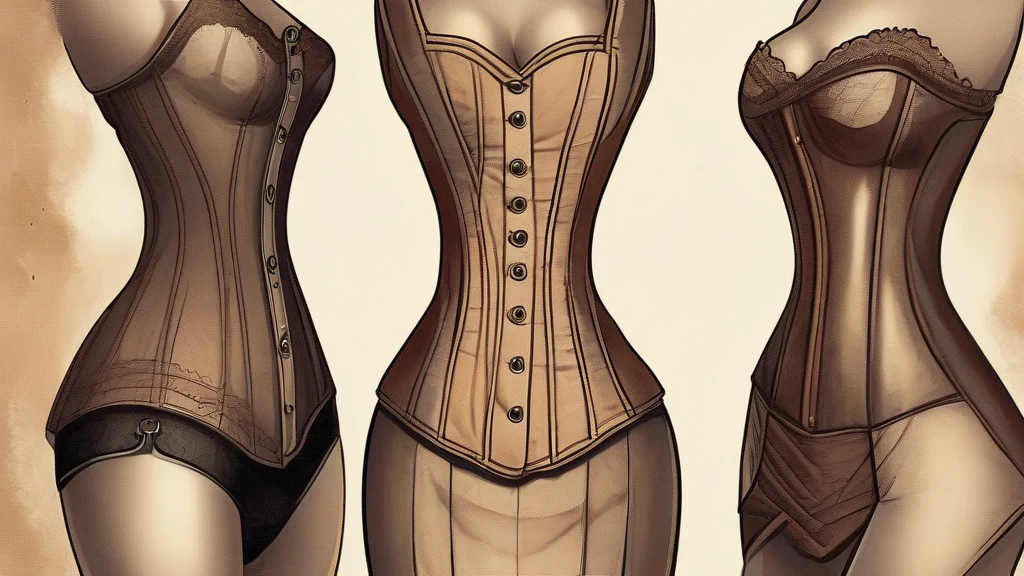
What does corsetry mean?
Corsetry refers both to the skilled craft of making corsets and to such garments viewed collectively as a category of dress. A noun derived from 'corset', it entered general use in the nineteenth century as the corset trade became a major industry. The word appears most often in contexts of fashion design, costume history, theatrical wardrobe, and bespoke tailoring: one might speak of a designer 'trained in corsetry', a museum exhibit of 'Victorian corsetry', or a boutique offering 'bespoke corsetry'. Its connotations are largely artisanal and historical, evoking craftsmanship, structure, and the shaping silhouettes of earlier eras, though modern fashion has renewed its visibility through shapewear, bridal wear, and outerwear styled as corsets. Because it names a specialised field, corsetry is chiefly encountered in writing about fashion rather than casual speech, where 'corsets' or 'shapewear' would more likely be used.
nounThe craft, trade, or art of designing and making corsets and similar closely fitted supporting undergarments; also, collectively, such garments themselves.
- The craft or profession of making corsets and closely fitted supporting undergarments.
- Collectively, the corsets and structured undergarments themselves, especially as a category of dress or fashion history.
"The museum's costume wing devoted an entire gallery to Victorian corsetry."
"After years of apprenticeship, she opened a studio specialising in bespoke corsetry for bridal wear."
"Fashion historians credit Dior's New Look with reviving interest in traditional corsetry after the war."
Rarely used; corsetry normally functions as an uncountable noun, and any plural sense is expressed by speaking of individual corsets instead.
"The exhibition compared corsetries from several different eras."
For over three centuries, corsetry shaped not just fashion but literally bodies — and today it lives on everywhere from bridal salons to Beyoncé's stage costumes.
Reviewed by Deb Chak, Editor. AI-assisted content curated by RJS Tech Solutions LLP.
Etymology of corsetry
Corsetry derives from 'corset', which entered English in the late eighteenth century from French 'corset', a diminutive form based on 'cors', meaning 'body', ultimately from Latin 'corpus'. The suffix '-ry' was added in the manner of trade nouns such as 'jewellery' and 'millinery', denoting the craft or goods associated with the base word. It thus shares its root with other corpus-derived words such as 'corporeal', 'corsage', and 'corps'.
How corsetry is actually used
The word carries a somewhat specialist, craft-oriented register; it appears most often in fashion journalism, costume history, and the garment trade rather than everyday conversation. In British usage 'corsetry' has long been a standard trade term for the department or industry dealing with foundation garments; American usage historically preferred 'foundations' or 'corsetry' interchangeably, with 'corsetry' now dominant in both regions.
Easily confused with corsetry
A corset is the individual garment itself, while corsetry refers either to the craft of making such garments or to them as a collective category.