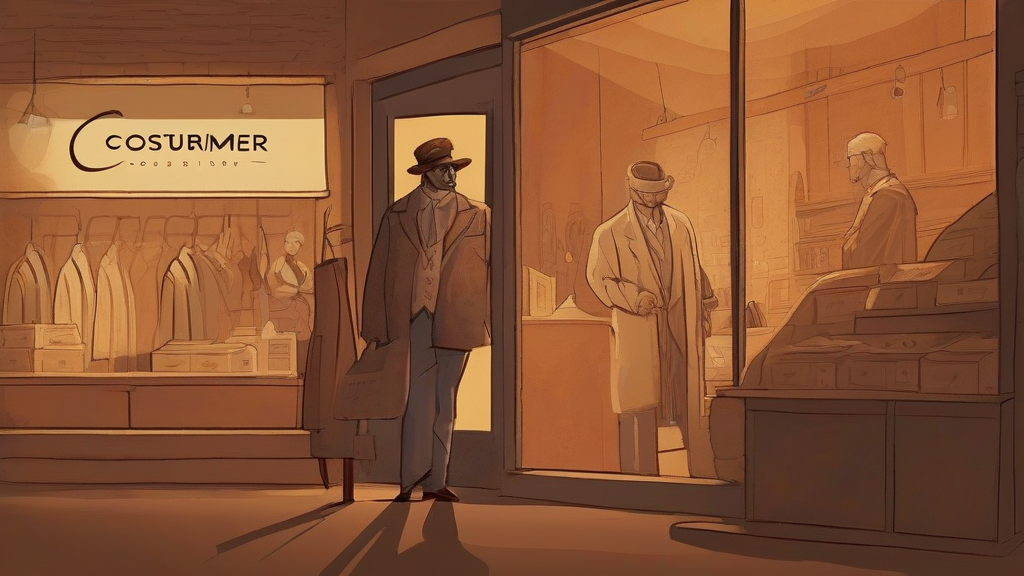
What does costumer mean?
A costumer is a person who makes, designs, supplies, or cares for costumes, particularly within the theatre, film, and television industries. The role sits at the heart of the wardrobe department: costumers may sew and alter garments, source period-accurate clothing, fit actors, and maintain the continuity and condition of every piece worn on stage or screen. The word derives from 'costume' and should not be confused with 'customer' — despite differing by a single letter, the two words are unrelated, and the mix-up is common enough to be a standing joke among wardrobe professionals. Costumers are credited in playbills and film end titles, often as 'head costumer' or 'resident costumer', and their craft blends tailoring skill with historical research and dramatic flair. An older, now obsolete sense of the word referred simply to an article of dress, but today it almost exclusively denotes the skilled tradesperson behind the costumes themselves.
nounA person whose occupation is making, designing, supplying, or caring for costumes, especially for theatres, films, or television. More rarely and archaically, it can denote an article of clothing; a suit of clothes.
- A person who designs, makes, supplies, or maintains costumes for theatrical productions, films, television, or other performances.
- (Archaic/rare) An article of clothing; a costume or suit of clothes.
"The theatre's costumer spent weeks sourcing authentic Victorian garments for the production."
"The production's costumer hand-stitched every bead onto the leading lady's gown."
"As head costumer for the opera company, she managed a wardrobe of over two thousand pieces."
Regular plural formation; used when referring to multiple wardrobe professionals.
"The studio hired three costumers for the historical epic."
Swap just one letter and 'costumer' becomes 'customer' — but this word belongs to the wardrobe department, not the checkout line.
Reviewed by Deb Chak, Editor. AI-assisted content curated by RJS Tech Solutions LLP.
Etymology of costumer
The word 'costumer' is formed from 'costume', which entered English from French in the early 18th century, itself deriving from Italian 'costume' meaning custom or fashion, ultimately from Latin 'consuetudinem', the accusative of 'consuetudo', meaning habit or usage. As theatrical and later film production professionalised, 'costumer' emerged as the occupational term for a maker or keeper of costumes. It shares its Latin root with words such as 'accustom', 'customary', and — through the same notion of habitual practice — 'customer'.
How costumer is actually used
The word is chiefly occupational and appears most often in contexts relating to the performing arts — theatre programmes, film credits, and industry publications. In everyday speech it is far less common than 'customer', with which it is frequently confused. The archaic sense referring to an article of dress is essentially obsolete in modern English.
Easily confused with costumer
A customer is someone who buys goods or services, while a costumer is someone who makes or supplies costumes — the two differ by only one letter but are entirely unrelated in meaning.