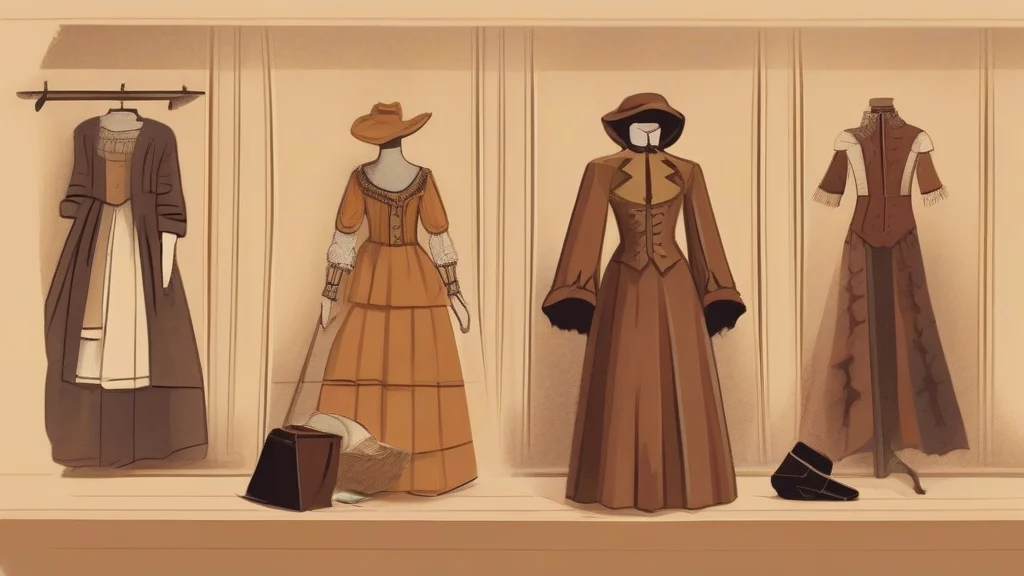
What does costuming mean?
Costuming refers to the costumes worn by performers in theatre, film, television, dance, and opera, viewed as a whole rather than as individual garments. It also names the craft behind those clothes: the design, selection, construction, and fitting of outfits that help define character, era, and mood. A production's costuming can be described as lavish, meticulous, authentic, or imaginative, and the field supports dedicated professionals known as costume designers. The word carries connotations of spectacle and transformation, since effective costuming allows an actor to inhabit a role visually as well as emotionally. Derived from 'costume', which entered English from French and ultimately Italian, the term is standard in both British and American English and appears most often in reviews, credits, and discussions of stage and screen production.
The costumes worn by performers in a production, regarded collectively; the practice or profession of designing and providing such costumes.
"The ballet's striking costuming helped transport the audience to imperial Russia."
Often used attributively with adjectives such as 'period', 'elaborate', or 'authentic'.
Present participle of the verb 'costume': to dress someone in a particular set of clothes, especially for a performance.
"They are costuming the chorus in richly embroidered robes for the new production."
Almost never pluralized; the noun is typically treated as uncountable, referring to costuming as a collective practice or body of garments.
Every Oscar for Best Costume Design is a tribute to costuming — a word that quietly covers both the glittering gowns you see on screen and the entire industry that puts them there.
Reviewed by Deb Chak, Editor. AI-assisted content curated by RJS Tech Solutions LLP.
Etymology of costuming
Costuming derives from 'costume', borrowed into English from French in the early 18th century, itself from Italian 'costume' meaning dress or custom, which traces back to Latin 'consuetudinem', meaning habit or usage. The noun form 'costuming' developed to describe both the collective wardrobe of a performance and the activity of providing it. It shares its Latin root with 'custom' and related words concerning established practice, reflecting the original sense of customary dress.
Related word forms
How costuming is actually used
Primarily used in theatrical, film, and fashion contexts; it sounds professional and technical rather than everyday. As a gerund it also functions as the verb 'costume' in continuous forms ('they are costuming the dancers'), though this verbal use is less common than the noun.
Easily confused with costuming
Customizing means modifying something to personal specifications, whereas costuming refers to clothing worn by performers or the craft of designing such clothing.