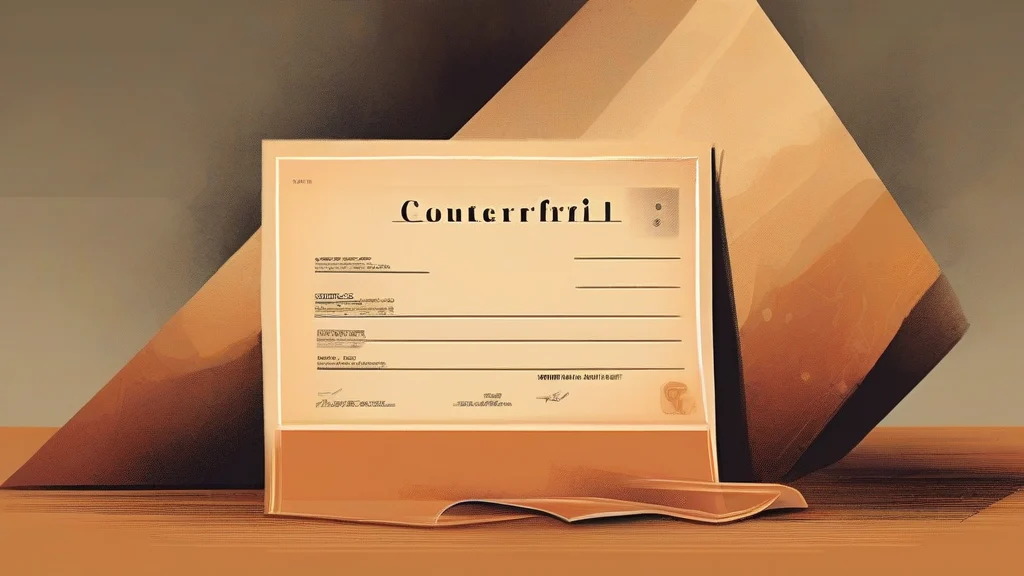
What does counterfoil mean?
A counterfoil is the portion of a document such as a cheque, ticket, or receipt that is retained by the issuing party when the main part is detached and handed over. It functions as a built-in record of the transaction: banks once used cheque counterfoils to track payments, and event organisers still use them to verify admission or run prize draws. The word is most at home in British English, where it appears on everything from raffle tickets to bank paying-in slips; American speakers typically say "stub" instead. Its register leans formal and administrative, giving it a faintly old-fashioned, paper-trail flavour in an increasingly digital world. Etymologically, it combines "counter-" (meaning counterpart or corresponding) with "foil," an old word for a sheet of paper or leaf. For anyone dealing with forms, tickets, or records, knowing this precise term is genuinely useful — it names an object everyone has handled but few can identify.
nounThe part of a cheque, ticket, receipt, or similar document that is kept or retained by the issuer when the main portion is given away, serving as a record of the transaction.
- The retained or duplicate part of a ticket, cheque, receipt, or similar document, kept as a record when the main portion is issued to someone else.
"He carefully tore the ticket along the perforation and slipped the counterfoil into his wallet as proof of purchase."
"Please fill in your details on the counterfoil and hand it back at the entrance."
"She kept every cheque counterfoil from that year, which made reconstructing her expenses remarkably easy."
Regular plural; commonly used when referring to batches of retained ticket or cheque portions.
"At the end of the night, she collected all the counterfoils for the raffle draw."
That little strip you keep after tearing off a ticket has been quietly proving things since the age of quill pens — and its name literally means 'against the leaf.'
Reviewed by Deb Chak, Editor. AI-assisted content curated by RJS Tech Solutions LLP.
Etymology of counterfoil
"Counterfoil" entered English in the late 16th or early 17th century, formed from "counter-" (in the sense of 'corresponding' or 'counterpart') plus "foil," an older English word meaning a thin sheet of paper or leaf. The compound thus originally denoted the corresponding leaf of a document kept alongside the one issued away. It belongs to a small family of words built on "foil" in this sense, including "trefoil" (a three-leafed plant) and "folio" (a leaf of a book), both ultimately traceable to Latin "folium," meaning leaf.
How counterfoil is actually used
"Counterfoil" is chiefly British; American English more often uses "stub" for the same thing. The word carries a slightly formal, bureaucratic register — common on tickets, banking documents, and official forms rather than in casual conversation.
Easily confused with counterfoil
A counterfeit is a fraudulent imitation of something valuable, whereas a counterfoil is the legitimate retained part of a document such as a ticket or cheque.
Counterpoint is a musical technique of combining independent melodic lines, while a counterfoil is a paper record kept from a torn or detached document.