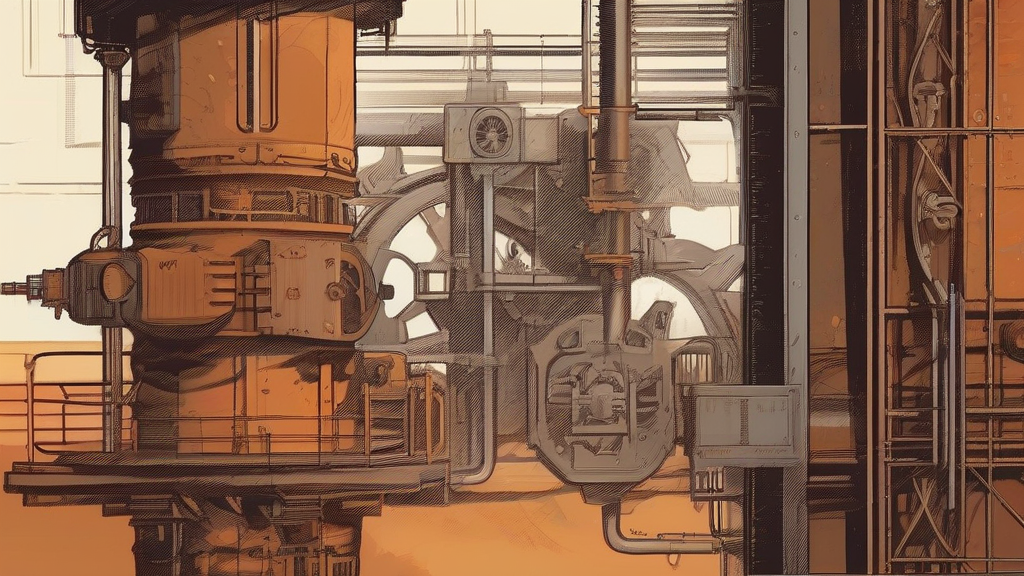
What does countershaft mean?
A countershaft is a secondary shaft used in mechanical systems to receive power from a main or line shaft and pass it along to other machinery, usually by means of belts or gears. The term belongs chiefly to mechanical engineering and machining, where countershafts serve practical purposes: they can change the speed of rotation by using pulleys of different sizes, redirect power at an angle, or bridge the distance between a central source of power and individual machines. The word arose in the era of steam- and water-powered factories, when a single overhead line shaft often drove dozens of machines at once, each tapping into the system through its own countershaft. Today the word appears mainly in descriptions of vintage workshop equipment, restoration projects, and engineering texts, though intermediate shafts performing the same function remain common in modern machinery under names such as jackshaft. For readers interested in industrial history, 'countershaft' is a small but telling window into how pre-electrification factories distributed mechanical energy.
nounA secondary shaft in a machine that is driven by the main or driving shaft and transmits power onward to other machinery, typically via belts or gears.
- A mechanical engineering term for an intermediate or secondary shaft that receives power from a main (line) shaft via belts or gearing and transmits it to working machinery, allowing changes of speed or direction.
"The old lathe's belt ran from the motor down to a countershaft mounted beneath the bench."
"Power came off the ceiling-mounted line shaft through a leather belt onto a countershaft below, which in turn drove the lathe's spindle."
"He fitted a smaller pulley on the countershaft to increase the drill press's speed."
Regular plural formation; used when referring to multiple intermediate shafts in a system or across machines.
"The mill's engine room contained a maze of belts connecting the main drive to the various countershafts throughout the building."
Before every machine had its own electric motor, factories hummed with overhead line shafts — and the humble countershaft was what brought that spinning power down to each workbench.
Reviewed by Deb Chak, Editor. AI-assisted content curated by RJS Tech Solutions LLP.
Etymology of countershaft
The word 'countershaft' is formed from the prefix 'counter-', meaning opposite or corresponding (from Latin 'contra', 'against'), combined with 'shaft', a native English word of Germanic origin denoting a long rod or bar. It emerged as a technical term during the Industrial Revolution, when factory machinery driven by central line shafts required intermediate shafts to distribute power to individual machines. Its cognates are not linguistic siblings so much as fellow compounds built on the same Latin root, including 'counterweight' and 'counterpart'.
How countershaft is actually used
A technical term used chiefly in mechanical engineering, machining, and discussions of historic factory machinery. Neutral in connotation; rarely encountered outside these contexts. In older American factory terminology, 'countershaft' was standard for the intermediate shaft between the main line shaft and an individual machine.
Easily confused with countershaft
A layshaft is an auxiliary shaft carrying gears that mesh with others (as in gearboxes), while a countershaft specifically receives its drive from a main line shaft and redistributes it.
A driveshaft is the primary shaft transmitting torque from an engine or motor, whereas a countershaft is a secondary shaft driven by it.