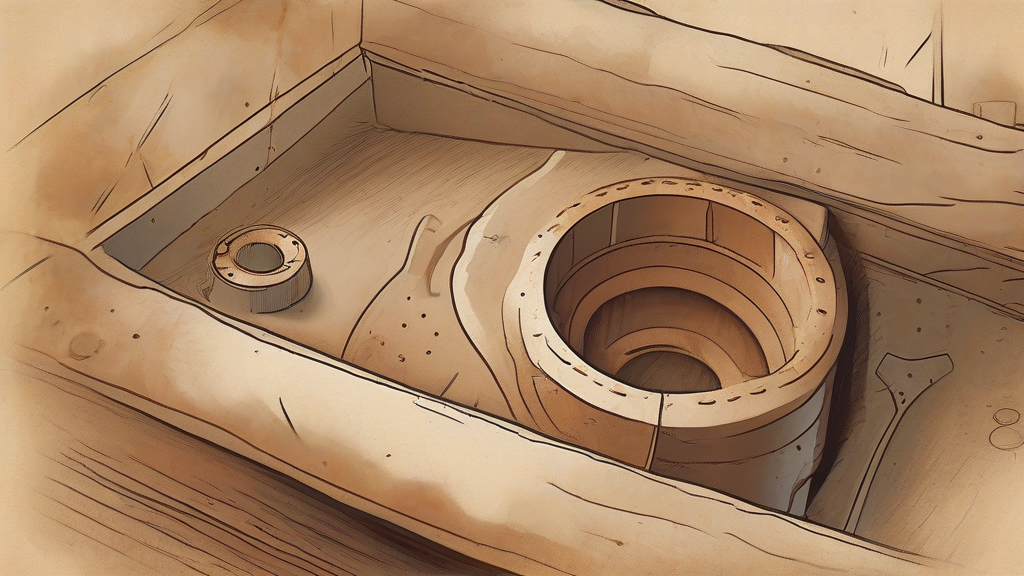
What does countersinking mean?
Countersinking is the workshop practice of widening the mouth of a drilled hole into a shallow cone so that the head of a flat-head or oval-head screw — or a rivet — can sit flush with, or slightly below, the surrounding surface. The result is both cosmetic and functional: fasteners no longer protrude to snag clothing, catch tools, or mar an otherwise smooth finish, which matters in cabinetry, aircraft assembly, and precision metalwork alike. The operation is performed with a countersinking bit, often after a pilot hole has been drilled, and the resulting angled recess may itself be called a countersink. The term belongs chiefly to carpentry, machining, and engineering jargon rather than everyday speech. It should not be confused with counterboring, which cuts a straight-sided cylindrical recess instead of a tapered one. Mastering countersinking is one of the small skills that separates rough assembly from finished craftsmanship.
nounThe process or technique of enlarging the top of a drilled hole with a conical tool so that a flat-head screw or rivet can sit flush with, or just below, the surrounding surface; also, a hole so prepared.
- The act or process of cutting a conical recess at the top of a hole so that a flat- or oval-head screw or rivet sits flush with the surface.
- The conical recess itself produced by this operation.
"Careful countersinking ensured that every screw head sat perfectly flush with the cabinet's surface."
"After pilot-drilling each hole, she finished the job with careful countersinking so the screws would sit flush."
"The machinist specified countersinking on all four mounting holes before the rivets were driven."
A well-done countersink is invisible by design — the best proof of good woodworking is that you can't see where the screws went in.
Reviewed by Deb Chak, Editor. AI-assisted content curated by RJS Tech Solutions LLP.
Etymology of countersinking
The word derives from the English compound 'countersink,' combining the prefix 'counter-' (meaning 'against' or 'opposite') with the verb 'sink,' first attested in English in the early nineteenth century as a technical term for setting a fastener head below a surface. The gerund 'countersinking' follows directly from that verb. Its components are native Germanic and Latinate English elements rather than borrowings, so it has few true cognates beyond other 'counter-' compounds such as 'counterbore' and 'counterweight.'
Related word forms
How countersinking is actually used
Primarily technical vocabulary found in carpentry, metalworking, machining, and DIY contexts. The verb is 'countersink' and its past form 'countersunk'; as a gerund it functions as a noun. It is neutral in register but rarely used outside workshop or engineering settings.
Easily confused with countersinking
Countersinking cuts a conical (cone-shaped) recess for a flat-head fastener, whereas counterboring cuts a straight cylindrical recess for a socket-head cap screw or washer.
Spotfacing flattens a small circular area around a hole to give a fastener a level bearing surface, while countersinking creates an angled recess to hide the fastener head.