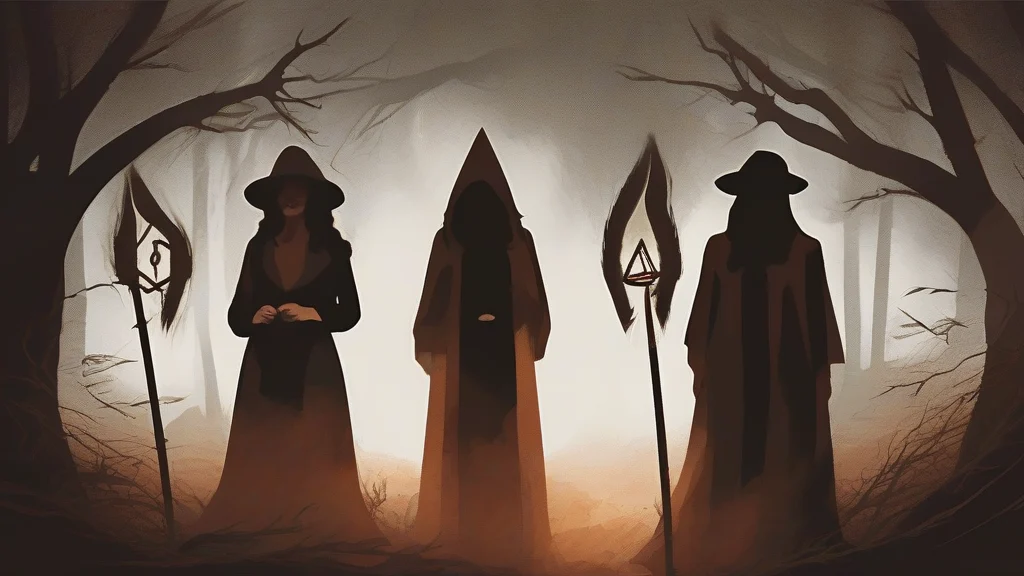
What does coven mean?
A coven is a gathering or organized group of witches, traditionally imagined as meeting at night to perform rituals. The word entered English usage in the seventeenth century through the records of Scottish witch trials, and it remains the standard term both in folklore and in contemporary Wicca and other neopagan religions, where it simply denotes a local congregation of practitioners. Beyond its literal magical sense, coven is often used figuratively and usually humorously to describe any small, exclusive circle of people — particularly a close group of friends who seem bound by secrets or shared rituals, as in calling one's longtime book club 'a proper coven.' Because of its associations with witchcraft, the word carries an air of mystery and secrecy, though in modern pagan contexts it is entirely neutral. Its blend of history, folklore, and everyday figurative use makes it a vivid and widely recognized word in English.
nounA group or gathering of witches, especially one that meets regularly for ritual purposes; in modern Wicca and neopaganism, an organized local group of practitioners.
- A gathering or community of witches, especially one practicing rituals together.
- By extension, any close-knit clique or secretive circle of people (often jocular).
"The novel follows a young witch who joins a coven hidden deep in the Louisiana bayou."
"According to legend, the coven gathered at midnight beneath the old oak to mark the solstice."
"In her memoir she jokes that her book club has become less a reading group than a coven."
Regular plural; used both literally for groups of witches and figuratively for cliques.
"Legends speak of covens meeting on remote hilltops under the full moon."
The word 'coven' first appeared in print in 1662 — spoken aloud by an accused Scottish witch, Isobel Gowdie, whose detailed confessions are among the richest records we have of early modern witchcraft beliefs.
Reviewed by Deb Chak, Editor. AI-assisted content curated by RJS Tech Solutions LLP.
Etymology of coven
Coven derives from the obsolete English word 'covent,' meaning an assembly or gathering, itself from Old French 'covine' (a group or company), ultimately rooted in Latin 'convenire,' meaning to come together. It is thus a cousin of words like convene and conventicle. The term is famously first attested in 1662, when the accused Scottish witch Isobel Gowdie used it in her trial confessions, and it was later popularized by Sir Walter Scott's writings on demonology and witchcraft.
How coven is actually used
The word carries strong supernatural connotations but is frequently used playfully or figuratively for tight-knit female friendships or cliques. In modern Pagan and Wiccan communities, it is the standard neutral term for a local working group and carries no negative sense.
Easily confused with coven
Cover means to place something over or conceal it, while a coven is a gathering of witches; the two words share letters but nothing else.
A convent is a Christian religious community of nuns, whereas a coven is an assembly of witches — the words are etymologically related but entirely distinct in meaning.