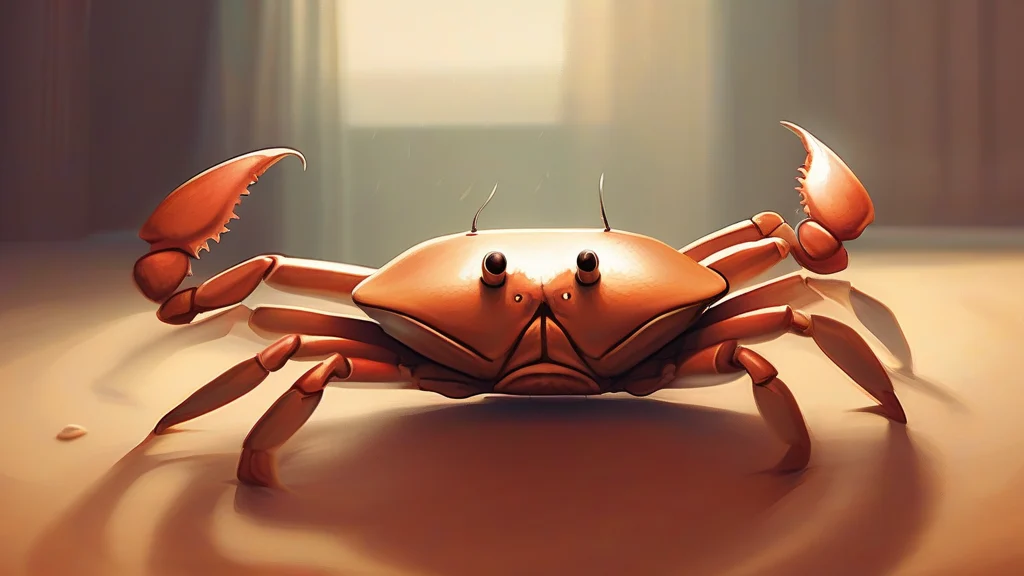
What does crablike mean?
"Crablike" is an adjective describing something that resembles a crab in appearance, posture, or manner of movement. Its most frequent application is to motion: a person who shuffles sideways, hunched and low, may be said to move crablike, as may animals that scuttle laterally across sand or rock. The word also appears figuratively, characterizing progress that is indirect, halting, or sideways rather than straight ahead — negotiations advancing crablike toward a conclusion, for instance. Formed from the familiar noun "crab" plus the productive English suffix "-like," it is transparent and immediately understandable even on first encounter. The term carries no strong connotation of praise or criticism, though its imagery often suggests caution, awkwardness, or stealth. Writers favor it when they want a compact, vivid alternative to lengthy descriptions of lateral or scuttling movement, making it a small but useful addition to descriptive vocabulary in both everyday and literary contexts.
adjectiveResembling a crab in appearance, movement, or manner, especially in moving sideways or with awkward scuttling motions.
- Resembling or characteristic of a crab in form or movement, especially moving sideways or with scuttling, awkward motions.
"The soldier advanced in a crablike crouch along the base of the wall."
"The fiddler crabs scattered in a crablike scramble across the mudflat."
"He edged crablike down the narrow ledge, unwilling to turn and face the drop."
The word 'cancer' literally means 'crab' in Latin — so every 'crablike' thing is etymologically a cousin of medicine's most feared diagnosis.
Reviewed by Deb Chak, Editor. AI-assisted content curated by RJS Tech Solutions LLP.
Etymology of crablike
Crablike is formed transparently within English from the noun "crab," which derives from Old English "crabba," related to similar words in Dutch and Low German. The suffix "-like" comes from Old English "-līc," meaning having the body or form of, and has long been used to build adjectives of resemblance. The word is therefore a relatively late, native English formation rather than a borrowing, and its relatives include other compounds such as "crabwise." More distantly, the Latin word for crab, "cancer," and Greek "karkinos" gave rise to terms like carcinoma, showing how widely the crustacean's name has traveled through language.
How crablike is actually used
Often used adverbially as well (e.g., 'to move crablike'), describing literal sideways or scuttling movement or figuratively awkward, indirect progress. Neutral to slightly vivid in register; common in nature writing, military and sports description, and literary prose.
Easily confused with crablike
Crabby means irritable or ill-tempered, while crablike describes physical resemblance to a crab or sideways movement.