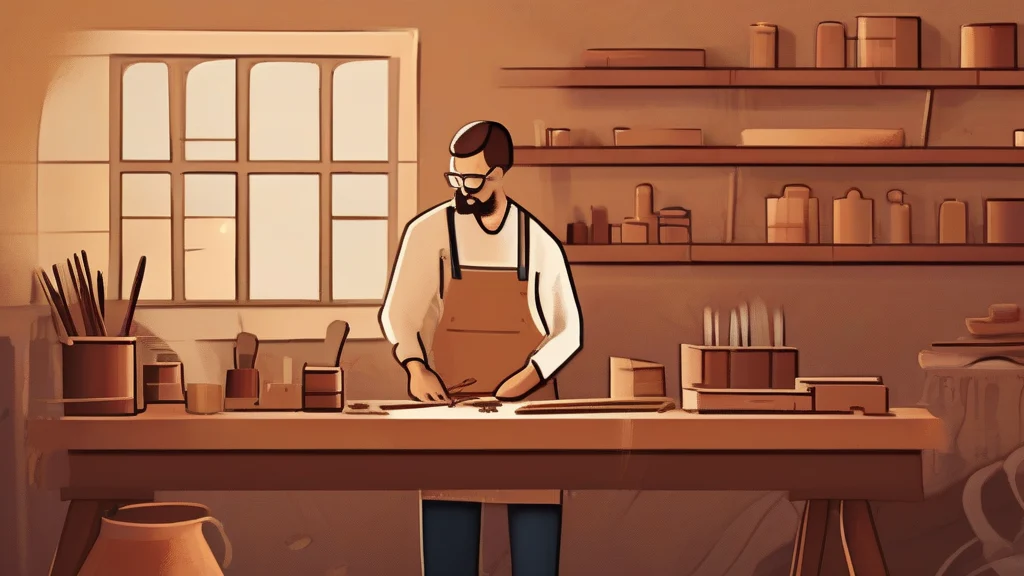
What does craftsperson mean?
A craftsperson is someone who practises a skilled manual craft or trade — such as carpentry, pottery, weaving, or metalwork — producing goods with expert technique and close attention to detail. The word functions primarily as a gender-neutral alternative to 'craftsman', coined to describe artisans of any gender, and it carries strong connotations of craftsmanship, pride in one's work, and high-quality output. It appears most often in contexts that celebrate traditional skills: galleries describing makers, businesses advertising handmade products, or discussions of heritage trades being kept alive. Common collocations include phrases like 'master craftsperson' and 'skilled craftsperson'. The plural form 'craftspeople' is widely used, particularly when referring collectively to members of a craft community or guild. For readers and writers alike, the word offers a precise, respectful way to honour the human skill behind handmade objects without defaulting to older gendered terminology, which is why it has become increasingly favoured in contemporary English.
nounA person who practices a craft or skilled trade, making things by hand with expert skill and care. The term is a gender-neutral alternative to 'craftsman'.
- A person skilled in a particular handcraft or trade, who makes objects by hand with expertise and artistry.
"Each piece of furniture in the workshop is shaped entirely by hand by a master craftsperson."
"The gallery showcases ceramics made by a local craftsperson."
"A true craftsperson never cuts corners on materials or finish."
Both 'craftspeople' (more common) and 'craftspersons' are accepted plural forms; 'craftspeople' is generally preferred in natural prose.
"The fair brings together over fifty craftspeople from across the region."
'Craftsperson' was coined as a gender-neutral twist on 'craftsman', proving that even centuries-old words can be reinvented for modern sensibilities.
Reviewed by Deb Chak, Editor. AI-assisted content curated by RJS Tech Solutions LLP.
Etymology of craftsperson
The word 'craftsperson' is formed from two well-established English elements: 'craft', from Old English 'cræft', meaning strength, power, or skill (a sense later narrowed to mean skilled manual work), and '-person', from Latin 'persona' via Old French. The compound emerged relatively recently as a deliberate coinage, arising during the twentieth century amid broader efforts to replace gendered occupational terms like 'craftsman' with neutral equivalents such as 'chairperson' and 'spokesperson'. Its cognates are therefore largely English compounds built on the same pattern rather than ancient relatives.
Related word forms
How craftsperson is actually used
'Craftsperson' carries connotations of skill, dedication, and quality workmanship. It is used in both formal and informal contexts and has become more common in contemporary usage as writers seek gender-neutral alternatives to 'craftsman' or 'craftswoman'. The plural is typically 'craftspeople', though 'craftspersons' also appears.
Easily confused with craftsperson
'Craftsman' is the traditional masculine form, whereas 'craftsperson' is a deliberately gender-neutral equivalent referring to anyone, regardless of gender.