
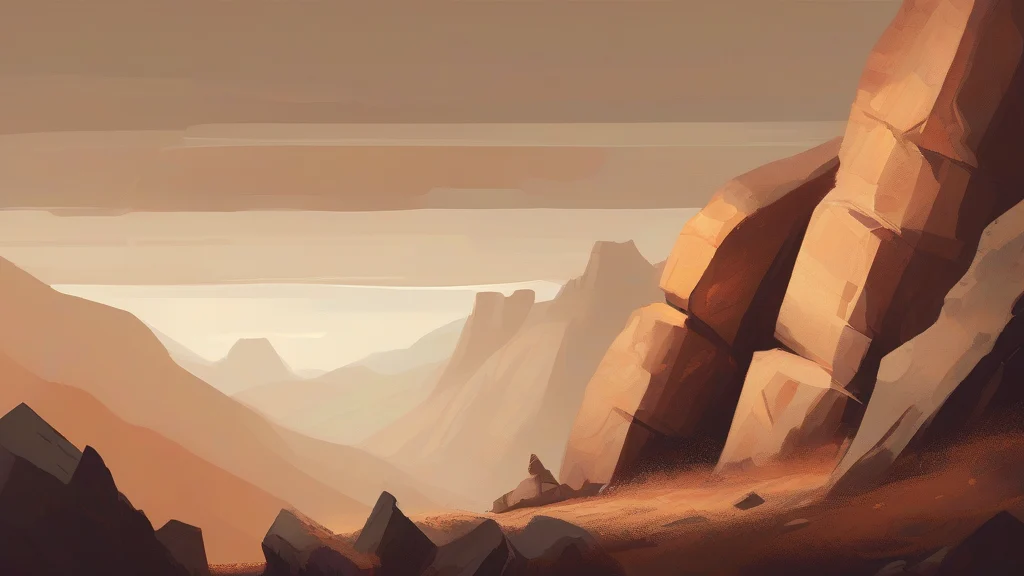
What does crag mean?
A crag is a steep, rugged projection of rock — an outcrop, cliff face, or jagged mass of stone that rises abruptly from its surroundings. The word belongs naturally to the vocabulary of mountains, coastlines, and moorland: British hillwalkers speak of climbing crags, ornithologists of seabirds nesting on sea crags, and novelists of characters with crag-like, weather-beaten features. It carries connotations of wildness, endurance, and unyielding terrain, which is why it appears so often in Romantic poetry and landscape painting. Closely related is the adjective "craggy," describing both actual rock formations and, figuratively, faces or hands marked by rough, angular character. A second, largely Scottish and Northern English sense uses "crag" for a bird's neck — an unrelated borrowing from Old Norse that survives mainly in dialect. For anyone writing about landscape, geology, or mountaineering, "crag" offers precision that blander words like "rock" cannot match.
A steep, rugged rock or rocky outcrop, especially one forming part of a mountain or cliff.
"Golden eagles nested high on the inaccessible crag above the loch."
Commonly used in British hillwalking and mountaineering contexts; often paired with specific rock types (e.g., "gritstone crag").
In Scottish and Northern English usage, the crop or neck of a bird.
"The farmer wrung the hen's crag before plucking it."
This sense is regional, increasingly rare, and unrelated etymologically to the rock sense.
Regular plural; used freely when referring to multiple rocky outcrops across a landscape.
"The coastline is broken by a succession of dark volcanic crags."
In parts of Scotland and northern England, "crag" doesn't mean rock at all — it means the neck of a bird, from an entirely separate Old Norse word.
Reviewed by Deb Chak, Editor. AI-assisted content curated by RJS Tech Solutions LLP.
Etymology of crag
The word "crag" meaning a rocky outcrop entered English in the late Middle Ages, likely borrowed from a Celtic source — compare Welsh "craig" — possibly reinforced by Old Norse "kragi." Its earliest recorded use appears in northern British texts, consistent with its strong association with Scottish and Pennine landscapes today. Separately, the dialectal sense meaning a bird's neck derives from Old Norse "kragi," making the two senses distinct etymological strands that converged on the same modern spelling.
How crag is actually used
"Crag" is most strongly associated with British landscape writing, hillwalking, and mountaineering vocabulary, though it is understood throughout the English-speaking world. It carries no strong register — equally at home in guidebooks and literary description. The dialectal sense referring to a bird's neck is now largely regional and rare. The adjective form "craggy" (as in "a craggy coastline") is more common in everyday speech than the noun itself in some contexts.
Easily confused with crag
"Crag" is the standard English noun for a rugged rock outcrop, while "Cragg" is typically a surname or place name rather than a common noun.