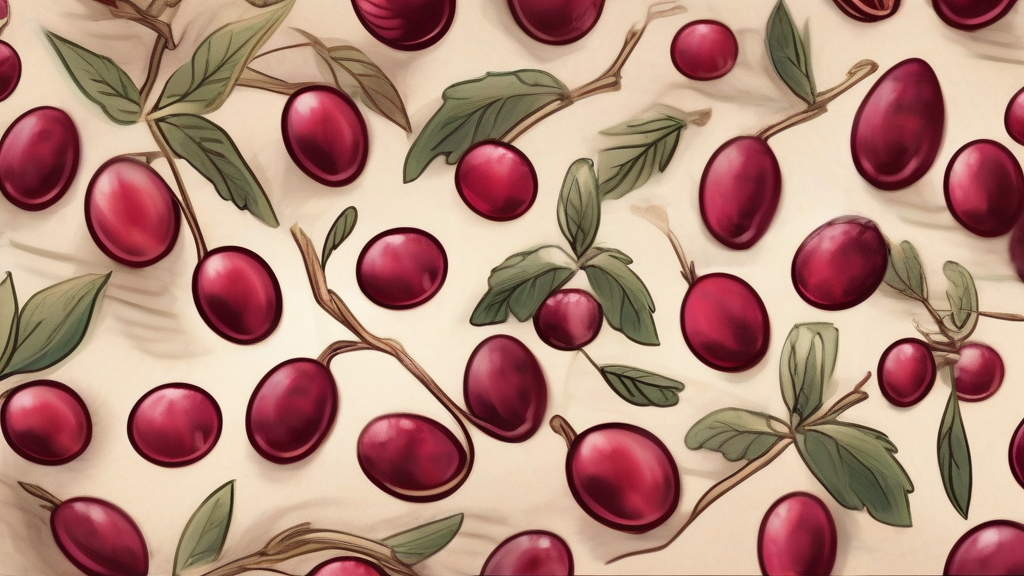
What does cranberry mean?
The cranberry is a small, firm, bright-red berry with a distinctly sharp, tart flavour, borne by low-growing evergreen vines of the genus Vaccinium, particularly Vaccinium macrocarpon of North America and the smaller European Vaccinium oxycoccos. Because the raw fruit is too sour to enjoy on its own, it is almost always eaten sweetened — most famously as cranberry sauce accompanying roast turkey at Christmas and Thanksgiving, but also as juice, dried snack fruit, jams, and baked goods. The word entered English in the seventeenth century, adapted from German settlers' 'craneberry', a name inspired by the crane-like shape of the flower. Beyond the kitchen, cranberries carry strong cultural associations with autumn holidays and North American agriculture, and they are prized nutritionally for antioxidants and compounds thought to help prevent urinary tract infections. In everyday speech the noun appears both countably ('a handful of cranberries') and as a mass noun ('too much cranberry'), and it frequently works attributively in familiar pairings such as cranberry sauce and cranberry juice.
nounA small, firm, red berry with a sharply tart taste, produced by low-growing evergreen shrubs of the genus Vaccinium, especially Vaccinium macrocarpon, native to North America. It is widely used in juices, sauces, and dried fruit preparations, and is traditionally served as a sauce with roast turkey.
- A small red tart edible berry of North American bog plants of the genus Vaccinium, used in cooking and drinks.
- The low-growing evergreen plant itself that produces this berry.
"The roast turkey came with a side of homemade cranberry sauce."
"She stirred fresh cranberries into the muffin batter for a burst of tartness."
"Cranberries thrive in the acidic bogs of Massachusetts and Wisconsin."
Standard plural, following the regular -y → -ies pattern after a consonant. Used when referring to individual berries; the singular is preferred when speaking of the fruit generically or as an ingredient.
"The recipe calls for two cups of fresh cranberries."
Cranberries get their name from 'craneberry' — early settlers thought the flower's beak-like parts resembled a crane's head.
Reviewed by Deb Chak, Editor. AI-assisted content curated by RJS Tech Solutions LLP.
Etymology of cranberry
The English word 'cranberry' derives from an adaptation of Low German or Dutch 'kraanbere' / 'cranebere' ('crane berry'), so named because the flower's stamens were thought to resemble the head and bill of a crane. The term was adopted by English speakers in North America during the early seventeenth century, replacing older names such as 'moss berry'. It is cognate with the modern German 'Kranichbeere'.
How cranberry is actually used
Usually treated as an uncountable mass noun when referring to the fruit in general (e.g. 'add some cranberry'), but takes the plural 'cranberries' when referring to discrete berries. Commonly used attributively (e.g. cranberry sauce, cranberry juice) where it functions like a compound modifier rather than a full adjective.
Easily confused with cranberry
A currant is a different small tart berry from the genus Ribes; 'cranberry' refers specifically to berries of the genus Vaccinium and is not a variant or misspelling of currant.