
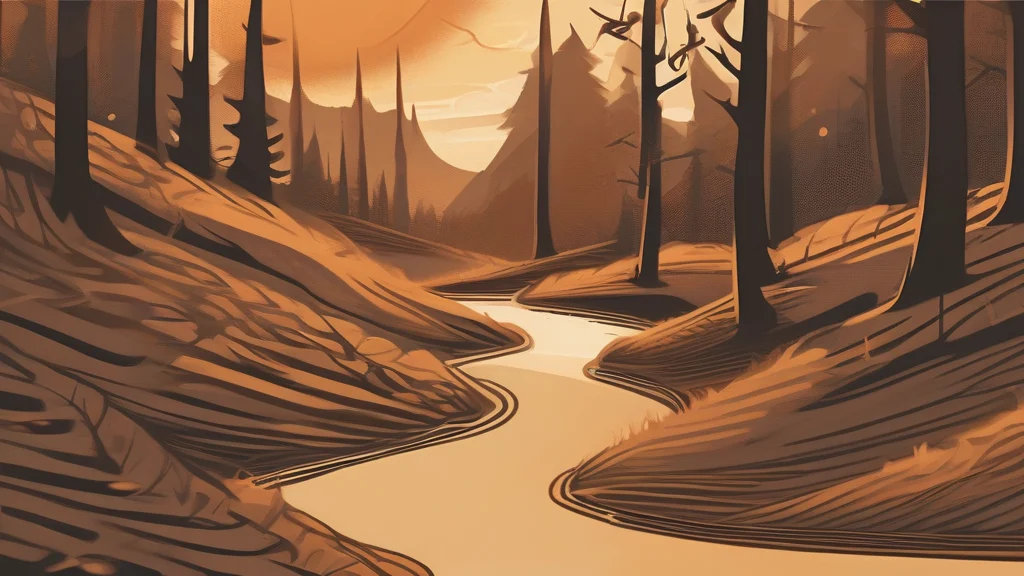
What does crankle mean?
Crankle is a rare English verb meaning to bend, wind, or move in a zigzag course, and it also exists as a noun denoting a single bend or twist in something such as a road, river, or boundary line. A lane that crankles does not run straight but loops and turns its way along, much as a stream meanders through a valley. The word derives from crank — the notion of angular turning familiar from a crankshaft — extended with the frequentative suffix -le, which suggests repeated motion. It belongs to a small family of similar-sounding words, including crinkle (small wrinkles) and cringle (a rope loop), from which it should be carefully distinguished. Crankle today is chiefly literary or dialectal, prized for its evocative, picturesque quality in descriptions of winding country paths and twisting waterways. Though uncommon, it offers writers a precise and charming alternative to more ordinary words like wind or twist.
To bend or turn in a winding, zigzag course.
"The trail crankles up through the pines to the summit."
Most often used of paths, roads, rivers, and lines.
A bend or winding turn in a road, river, or similar course.
"The cart slowed at every crankle in the mountain road."
Used when referring to multiple individual bends or turns.
"The map showed countless crankles in the coastline."
Crankle is what a lazy river does — the word itself bends back to 'crank,' the same root behind the zigzag shape of an old engine's crankshaft.
Reviewed by Deb Chak, Editor. AI-assisted content curated by RJS Tech Solutions LLP.
Etymology of crankle
Crankle originated in English, likely in the sixteenth century, as an extension of the older word crank, which denotes a bend or an angled turning device such as a crankshaft. The addition of the frequentative suffix -le, common in English word formation, gave it the sense of repeated bending or winding. It thus shares ancestry with related formations such as crinkle and with the broader Germanic root behind crank.
Related word forms
How crankle is actually used
Crankle is rare and somewhat old-fashioned or literary in register; it appears most often in descriptive prose about landscape. It carries a gently picturesque connotation rather than any negative one.
Easily confused with crankle
Crinkle means to form small wrinkles or creases (as in paper or fabric), while crankle refers to larger bends or winding turns along a course or line.