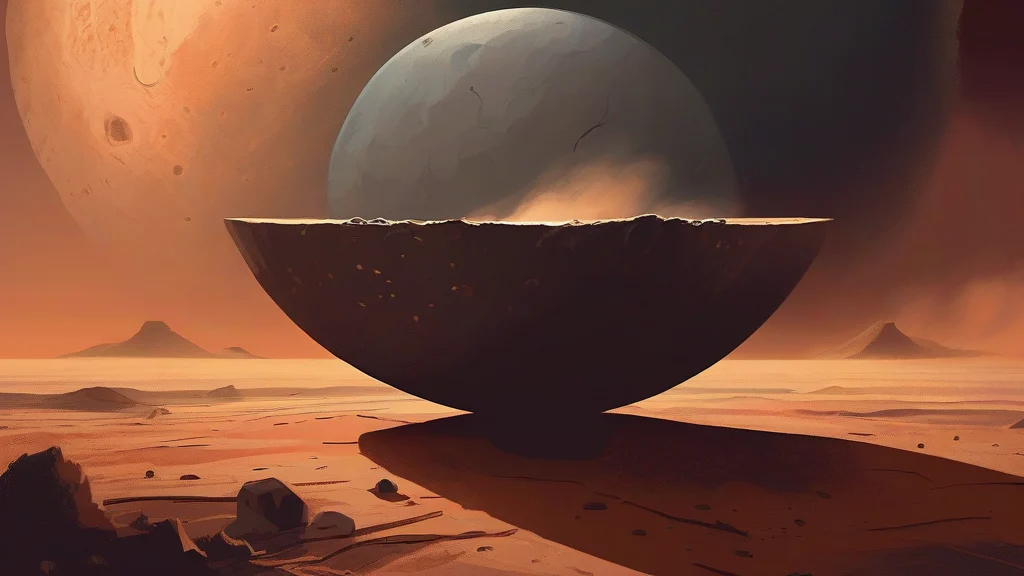
What does crater mean?
A crater is a large, roughly circular, bowl-shaped hollow in a surface. The word most often describes depressions formed when a meteorite strikes a planet or moon, but it also names the basin at the summit of a volcano, surrounding the vent through which lava and ash escape. Familiar examples include Meteor Crater in Arizona and the vast craters pockmarking the lunar surface, which record billions of years of bombardment. Beyond these scientific uses, 'crater' appears figuratively for any dramatic hole or dent — a pothole 'deep as a crater' — giving the word a vivid, slightly exaggerated connotation in casual speech. The term is standard across geology, astronomy, and everyday English, with no significant regional variation between British and American usage. Because craters are among the most striking features visible on other worlds, the word carries strong associations with space exploration and planetary science.
A large bowl-shaped cavity in the ground or on the surface of a celestial body, caused by an explosion or the impact of a meteorite.
"The meteorite left a crater half a mile across."
This is the dominant modern sense, especially in planetary science and journalism about space events.
The bowl-shaped mouth or opening of a volcano, situated above its vent.
"Hikers peered over the edge of the dormant volcano's crater."
Often called a 'volcanic crater'; this was historically the earliest English use of the word.
Standard plural; used freely when discussing multiple formations, as in lunar or Martian surface descriptions.
"The Moon's surface is scarred by millions of craters of every size."
The word 'crater' originally referred to the mixing bowl used at Greek drinking parties — astronomers borrowed it because lunar craters looked like cups.
Reviewed by Deb Chak, Editor. AI-assisted content curated by RJS Tech Solutions LLP.
Etymology of crater
The word 'crater' comes from Latin 'crater', meaning a mixing-bowl or goblet, which itself derives from Greek 'kratēr', the wide vessel used to mix wine with water at Greek symposia. The term was first applied in English, from around the early 17th century, to the cup-shaped depression at the top of a volcano, whose form resembled such a vessel. Later the sense broadened to include cavities formed by explosions and meteorite impacts, especially as interest in lunar and planetary features grew. A related borrowing is the constellation name Crater, representing the cup, again drawn from the same Greek root.
Related word forms
How crater is actually used
In scientific contexts (geology, astronomy, planetary science), 'crater' is neutral and technical. In everyday speech it is often applied figuratively to any deep hole or dent, sometimes humorously ('a pothole like a crater'). The volcanic sense and the impact sense are distinguished by context rather than by different wording.
Easily confused with crater
A 'crater' is a bowl-shaped cavity, while a 'creator' is someone who makes or brings something into existence — the two words share no meaning despite a superficial resemblance.