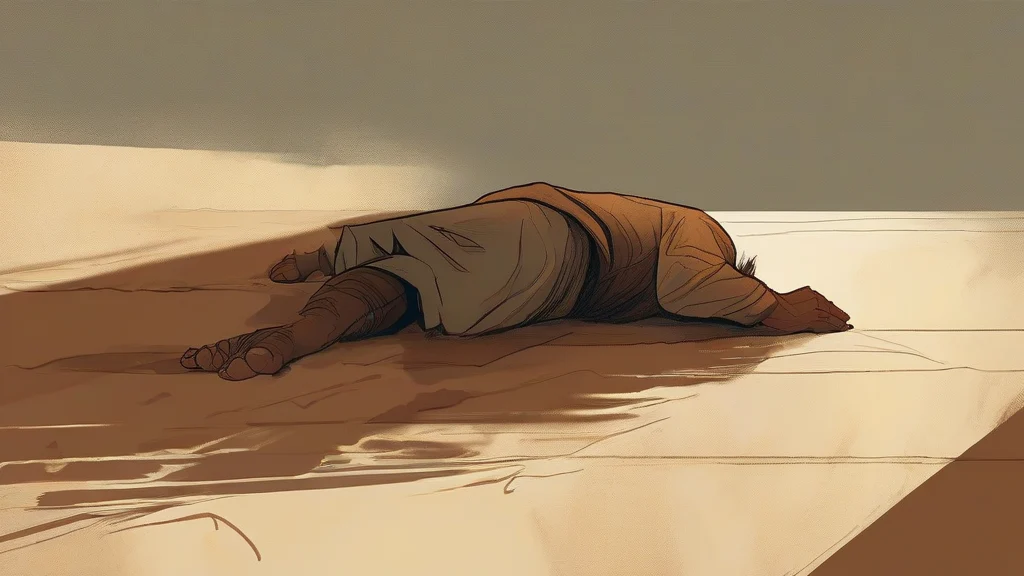
What does crawl mean?
To crawl is to move slowly while keeping the body close to the ground, whether literally on the hands and knees, as babies and soldiers do, or by dragging oneself along after an injury. The word extends readily to anything that advances painfully slowly: traffic can crawl through a congested city centre, and time itself may seem to crawl during a dull afternoon. A further figurative use describes servile behaviour — someone who 'crawls' to a superior acts in a fawning, self-abasing way, a sense that carries strong disapproval. In sport, the crawl (usually the front crawl) names the fastest swimming stroke, with alternating overhead arms and a fluttering kick. Related expressions such as 'crawl space' (a shallow accessible gap beneath a building) and 'make one's skin crawl' (to cause revulsion) show how deeply embedded the word is in everyday English.
To move forward on the hands and knees or by dragging the body close to the ground; to advance extremely slowly.
"The wounded soldier managed to crawl to cover."
Common both literally and figuratively; the figurative use for slow movement is especially frequent.
To behave in an obsequious or servile manner.
"He hated having to crawl to his supervisor for a favour."
Informal and pejorative.
An act of crawling, or a very slow rate of movement; also, in swimming, the front crawl stroke.
"We did a pub crawl through the old town."
In compound phrases such as 'pub crawl' and 'crawl space'.
As a noun, 'crawl' takes a regular plural; it most often appears in the plural in compounds like 'pub crawls' or when referring to repeated instances of slow movement.
"The city's best-known pub crawls attract hundreds of visitors each weekend."
Babies the world over learn to crawl before they walk — and so does traffic on a Monday morning.
Reviewed by Deb Chak, Editor. AI-assisted content curated by RJS Tech Solutions LLP.
Etymology of crawl
'Crawl' comes from Middle English crawlen, which appears to have been borrowed from or influenced by Old Norse krafla, meaning 'to claw or paw at the ground'. It belongs to a small group of everyday movement verbs that entered English through Scandinavian contact during the medieval period, gradually displacing or coexisting with native alternatives. The word has been in continuous use since the Middle Ages, and its figurative senses — slow progress and servile behaviour — developed naturally from the image of low, laborious bodily movement.
Related word forms
How crawl is actually used
Fully standard in both British and American English across registers. The figurative sense of moving slowly ('the traffic was crawling') and the literal sense are both common; the obsequious sense ('he crawled to the boss') carries a strongly negative connotation and is somewhat informal. In swimming, 'the crawl' usually refers specifically to the front crawl.
Easily confused with crawl
A 'craw' is the crop of a bird or insect, used idiomatically as in 'sticks in my craw', whereas 'crawl' is the slow movement described above.