
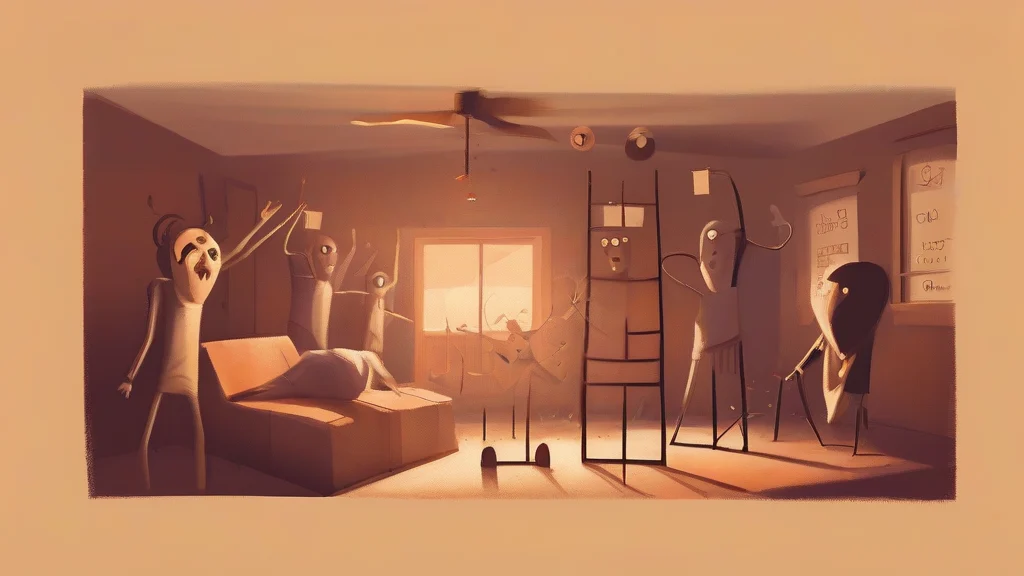
What does craziness mean?
Craziness is the quality or state of being crazy — behaving or thinking in a wild, foolish, or irrational way. As a noun formed from the adjective 'crazy' plus the suffix '-ness', it names both individual acts of recklessness and broader atmospheres of chaos, as in 'the craziness of the holiday rush'. The word carries strong informal connotations and is common in everyday conversation, journalism, and casual writing, where it can express exasperation, disbelief, or affectionate amusement. Historically it descends from Middle English 'craze', meaning to shatter or break, which also gave rise to 'craze' for an obsession and to the verb describing fine surface cracks in pottery and paint. Because 'crazy' has been used pejoratively about mental illness, careful writers often reserve 'craziness' for figurative or playful uses rather than clinical descriptions, choosing more precise language when discussing actual psychiatric conditions.
nounThe state or quality of being crazy; wildly foolish, irrational, or mentally unbalanced behavior or thinking.
- Wild, foolish, or senseless behavior or ideas
- A state of intense excitement or chaos (informal)
- Mental illness (dated, now generally avoided in formal contexts)
"The sheer craziness of driving through that blizzard left her family speechless."
"The craziness of the holiday season leaves everyone exhausted by December."
"He questioned the craziness of quitting his job without another one lined up."
Rarely used; the plural appears mainly in formal or technical contexts, as most usage treats craziness as an uncountable quality.
"The report catalogued the various crazinesses of the past year's market speculation."
It comes from 'craze', a 14th-century word for being shattered or cracked — so calling something crazy literally once meant it was broken.
Reviewed by Deb Chak, Editor. AI-assisted content curated by RJS Tech Solutions LLP.
Etymology of craziness
Craziness derives from the adjective 'crazy' plus the noun-forming suffix '-ness', first appearing in English around the late sixteenth century. Its root, 'craze', entered Middle English from Old Norse 'krasa' (to shatter), originally meaning to break into pieces before shifting to mean mental derangement. The same root produced 'craze' for a short-lived fashion obsession and survives in the ceramics term 'crazing' for networks of hairline cracks.
How craziness is actually used
Informal to neutral in register. In modern sensitive usage, avoid implying clinical mental illness; prefer terms like 'mental illness' in medical or formal contexts.
Easily confused with craziness
Crazing refers to a network of fine cracks in materials like ceramic glaze or paint, whereas craziness means wild or irrational mental state or behavior.
Laziness is an unwillingness to work or exert effort, while craziness denotes wildness or irrationality.