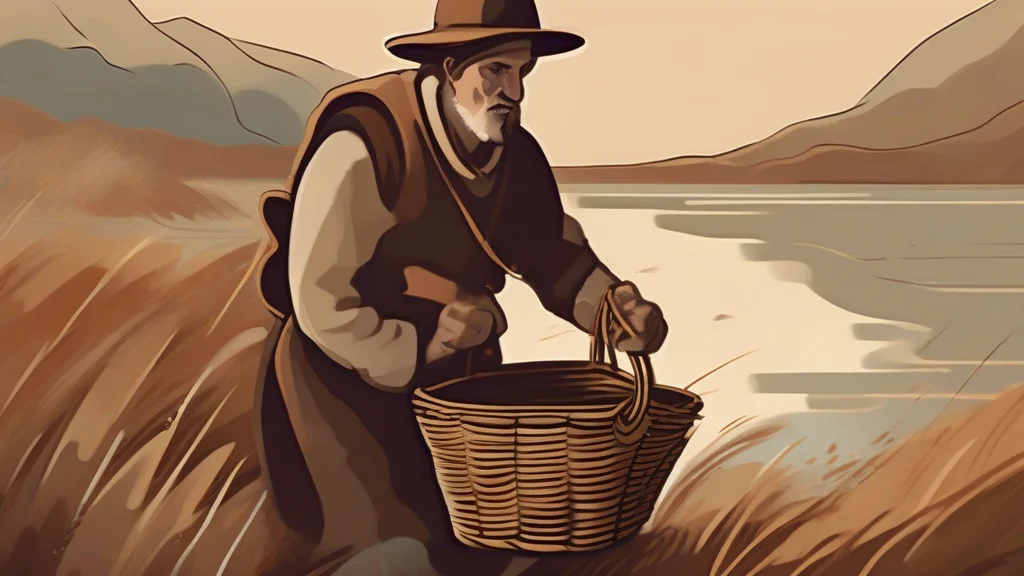
What does creeling mean?
Creeling refers to the act of carrying or filling a creel — a sturdy wicker basket long used in Britain, particularly Scotland and northern England, for hauling fish, peat, and other burdens, typically slung on the back. The word functions as the gerund or present participle of the verb 'creel' and evokes the physical labor of fishing communities and crofting life. Beyond its literal sense, creeling names a curious Scottish wedding tradition in which the bridegroom was made to carry a creel weighted with stones while friends and relatives chased him; the ritual ended only when the bride came out and released him, symbolising her acceptance. Today creeling survives mainly in regional dialect, historical writing about fishing and rural labour, and folklore accounts, giving it an evocative, old-world character that connects readers to centuries of coastal and agricultural working life.
The act or process of carrying or filling a creel, a wicker basket used for transporting fish, peats, or similar loads.
"Creeling was among the hardest tasks on the herring fleet's busiest mornings."
Chiefly Scottish and northern English; often encountered in descriptions of traditional fishing and crofting work.
A traditional Scottish wedding custom in which a creel weighted with stones was carried by the bridegroom until freed by the bride.
"The couple revived the custom of creeling at their Orkney wedding."
Recorded mainly in accounts of Scottish and Northern Isles folk traditions; rarely used outside this context.
In old Scottish weddings, a groom might be made to run with a heavy creel of stones strapped to his back until his bride cut him free — a test of devotion called 'creeling'.
Reviewed by Deb Chak, Editor. AI-assisted content curated by RJS Tech Solutions LLP.
Etymology of creeling
Creeling derives from 'creel', a Middle English word for a large wicker basket, which itself traces back through Old North French 'creille' or 'cueil' and ultimately to a Germanic root shared by words such as 'cradle' and 'crate', all denoting woven containers or frameworks. The verb 'creel' arose from the practice of loading or carrying these baskets, and its -ing form naturally describes that action. The word has been especially persistent in Scots and northern English dialects, where creels remained everyday equipment into recent times, and the wedding custom of 'creeling' the bridegroom is recorded in Scottish folklore.
Related word forms
How creeling is actually used
The word is largely regional and historical today, surviving chiefly in Scottish and northern English dialect contexts and in accounts of folk customs. In modern usage it appears mostly in writing about fishing heritage or traditional weddings rather than everyday speech.
Easily confused with creeling
Crenelation refers to the battlements on a wall or roof, whereas creeling relates to wicker baskets and carrying loads.
Keeling means overturning or capsizing (as a boat keels over), while creeling involves carrying goods in a creel.