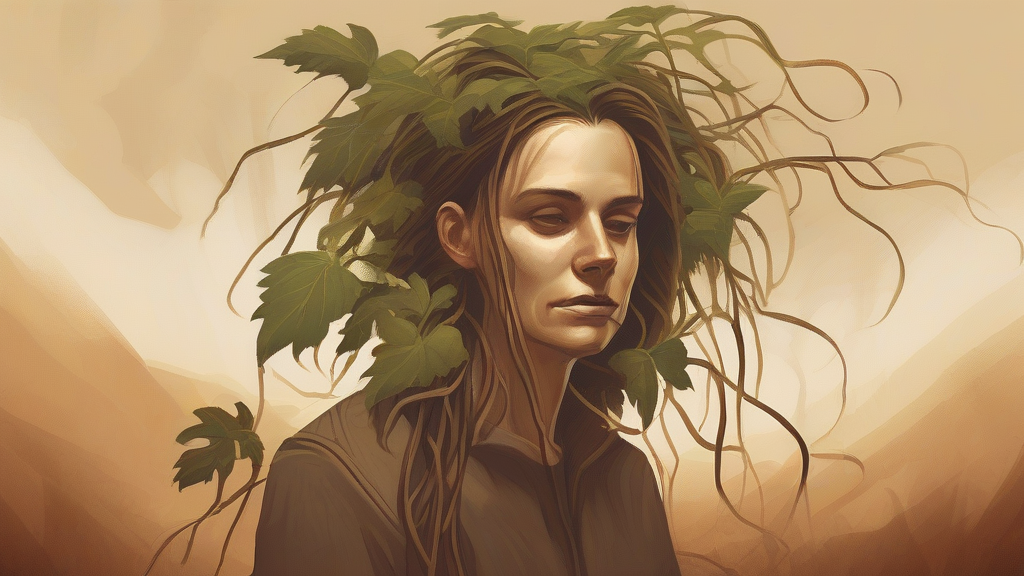
What does creeper mean?
A creeper is, first and foremost, a plant that climbs or trails along surfaces — walls, fences, trees, and ground — anchoring itself with tendrils, suckers, or aerial roots rather than a woody trunk. Familiar examples include Virginia creeper and Boston ivy, staples of gardens and architecture for centuries. Beyond botany, the word has drifted into figurative territory: because such plants spread silently and unseen, a creeper came to mean anything that advances slowly or furtively, including a vehicle mechanic's low rolling board and, in basketball, a softly arced shot. Most strikingly, modern informal English uses creeper for a person whose behavior feels unsettlingly intrusive — someone who lurks or watches without invitation. This slang sense is strongly negative and best avoided in formal writing, where it may read as insulting. The word derives simply from the verb creep plus the agent suffix -er, so its core image — something that creeps — unites all its meanings, from ivy on a wall to an unwelcome presence online.
nounA plant that grows by spreading along the ground or climbing by means of suckers, tendrils, or rootlets; also, a person or thing that moves slowly, quietly, or stealthily. In informal modern usage, it denotes a person who behaves in a creepy or unsettling manner.
- A plant that climbs or spreads along a surface using tendrils, suckers, or aerial roots.
- Informal: a person whose behavior causes unease or disgust; someone regarded as creepy.
- A person or animal that moves slowly, stealthily, or close to a surface.
- A low wheeled board or trolley used to slide beneath vehicles during repair work.
- In basketball, informal: a soft shot made with a gentle underhand arc, dropping into the basket.
"Ivy is a vigorous creeper that will quickly cover an entire garden wall."
"Boston ivy is not a true ivy but a creeper that clings to brickwork with adhesive pads."
"She blocked him after realizing he had been lurking on her profile like a total creeper."
Regular plural. In the plural, creepers most commonly refers either to multiple climbing plants or, in American usage, to babies' one-piece snap-crotch garments.
"Tropical creepers draped the ruins in green."
The same word that names ivy clinging to a cottage wall has, in the age of social media, come to name someone you'd rather not find lingering behind you — a botanical term turned warning label.
Reviewed by Deb Chak, Editor. AI-assisted content curated by RJS Tech Solutions LLP.
Etymology of creeper
Creeper was formed in Middle English from the verb creep, which descends from Old English crēopan ("to bend the body, crawl"), plus the agentive suffix -er. It originally denoted any creature or thing that creeps, and by extension a plant that creeps up walls or across the ground. The word's cognates lie within the Germanic family: Dutch kruipen and German kriechen share the same Proto-Germanic root. The modern pejorative sense for an unpleasant person developed much later, as an extension of creepy, itself a nineteenth-century derivative of the same verb.
Related word forms
How creeper is actually used
The horticultural sense is neutral and standard in both British and American English. The slang sense for an unsettling person is distinctly informal and carries strong negative connotation, common especially in American English and online contexts. The mechanical and sporting senses are technical or regional jargon.
Easily confused with creeper
"Creep" is the base verb meaning to move slowly and stealthily (and informally, an unpleasant person), while "creeper" is the noun form referring chiefly to a climbing plant, a slow-moving thing, or such a person.
A "crisper" is the drawer in a refrigerator used for storing vegetables, unrelated in meaning to "creeper" despite the similar sound.