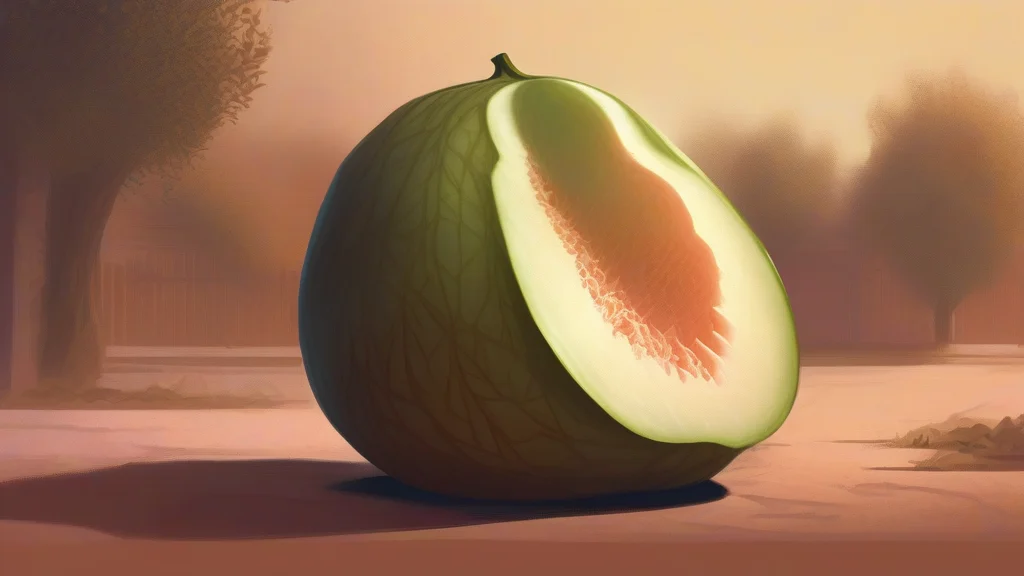
What does crenshaw mean?
Crenshaw is best known today as the name of a distinctive winter melon prized for its sweetness. Large and oval with smooth skin that turns from green to golden yellow as it ripens, the crenshaw has pale salmon-orange flesh that is exceptionally juicy and sugary, making it a late-summer favorite at markets across North America. Unlike ancient fruits such as figs or grapes, it is a modern creation: breeders crossed a casaba melon with a Persian melon to produce it, giving it the casaba's spicy-sweet undertones and the Persian melon's lush texture. Because it is a winter melon, it stores longer than many summer varieties, extending its season well past peak harvest. Beyond the fruit, the capitalized form appears as a family surname and in the name of Crenshaw Boulevard and its surrounding district in Los Angeles. For cooks, choosing a ripe one means trusting weight and fragrance over color alone.
nounA large winter melon with yellow-green skin and sweet, salmon-pink flesh, produced by crossing a casaba with a Persian melon.
- A type of large, sweet-fleshed winter melon (the Crenshaw melon), a casaba–Persian melon cross.
- (capitalized) A surname; also the name of a well-known neighborhood and boulevard in Los Angeles.
"The farmers market had its first crenshaws of the season, their golden rinds promising honeyed flesh inside."
"Slice the chilled crenshaw into wedges and serve it with prosciutto as a summer starter."
"He grew up near Crenshaw Boulevard, where the neighborhood's culture shaped his music."
Regular plural, used when referring to multiple fruits of this variety.
"The crate held six crenshaws, each one heavier than it looked."
Unlike nearly every fruit you can name, the crenshaw is not an ancient heirloom but a deliberate twentieth-century American hybrid — bred, not discovered.
Reviewed by Deb Chak, Editor. AI-assisted content curated by RJS Tech Solutions LLP.
Etymology of crenshaw
As a fruit name, "Crenshaw" derives from the surname of the American grower credited with developing the melon, a hybrid of the casaba and Persian melons produced in the United States in the early twentieth century. The surname itself is of English origin, traditionally interpreted as coming from a habitational name meaning "Crena's nook" or "Crena's corner," from an Old English personal name combined with a term for a river bend or secluded spot. Its use as a place name in Los Angeles reflects the same surname tradition rather than the melon.
Related word forms
How crenshaw is actually used
In culinary contexts "crenshaw" almost always refers to the melon and is often written lowercase; when capitalized, it typically denotes the surname or the Los Angeles place name. The word is far more common in North America than elsewhere.
Easily confused with crenshaw
A casaba is one parent of the crenshaw — a paler, more mildly sweet melon with wrinkled yellow skin — whereas the crenshaw is larger, juicier, and has smooth green-gold skin.