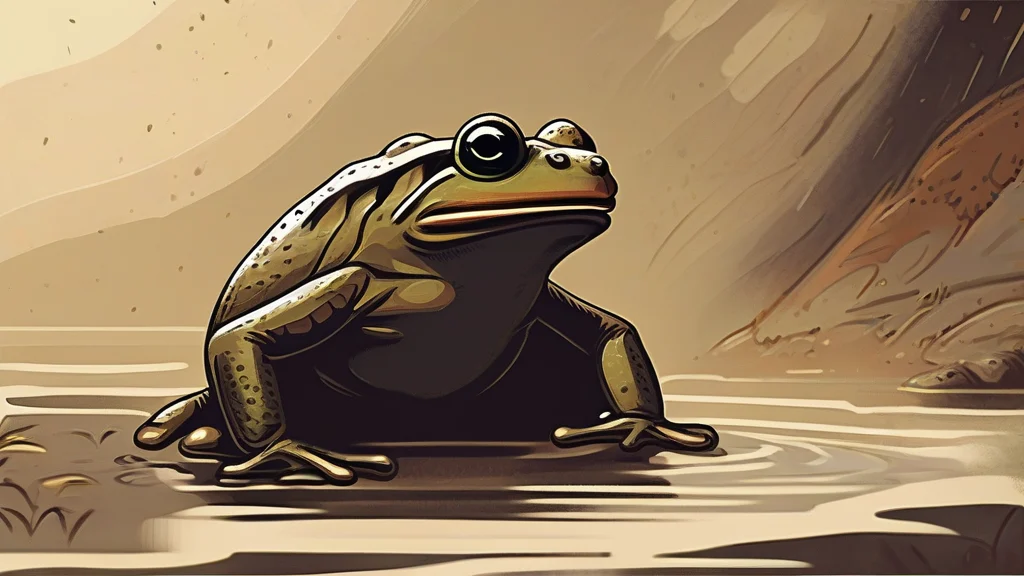
What does croak mean?
Croak is a verb describing a distinctive kind of sound: deep, harsh, and hoarse, like the call of a frog or the caw of a raven. Its most familiar use is zoological — frogs croak, especially during mating season when males call loudly from ponds and marshes. By extension, it describes any similarly rough, grating noise, whether made by animals, rusty machinery, or a human voice worn down by illness, age, or emotion: someone might croak a single word through a dry throat. In informal British and American usage, croak carries a second, darker meaning — simply to die — a piece of slang that is mildly comic rather than solemn, so best avoided in serious contexts. The word can also function as a noun ('the croak of a raven'), referring to the sound itself. Vivid and onomatopoeic in character, croak is useful precisely because no more neutral verb captures quite this particular quality of sound.
To make a deep, hoarse, harsh sound, especially as a frog does; to utter something in a rough, low voice; informally, to die.
"He could barely croak out an apology before the line went dead."
Often used with 'out' when referring to speech produced with difficulty.
A deep, hoarse, harsh sound such as that made by a frog or raven; informally, a death.
"We heard the croak of a heron somewhere above the reeds."
Used only for the noun form referring to sounds (or, informally, deaths); not applicable to the verb.
"The evening air was thick with the croaks of courting frogs."
Frogs don't just make noise — they croak, and so do ravens, dying engines, and (in British and American slang) people taking their last breath.
Reviewed by Deb Chak, Editor. AI-assisted content curated by RJS Tech Solutions LLP.
Etymology of croak
Croak appears to be of imitative origin, arising in Middle English as an attempt to reproduce the harsh sound itself rather than deriving from another word root. It is first attested in English texts around the late medieval period and has remained remarkably stable in both form and meaning since then, consistently associated with frogs, ravens, and other rough-voiced creatures. Because it developed directly from sound imitation rather than from Latin or Greek roots, it lacks classical cognates.
How croak is actually used
The verb is most often used literally for frogs and other animals, and figuratively for humans speaking in a rough, strained voice — usually after illness, exhaustion, or emotion. The slang sense 'to die' is distinctly informal and slightly darkly humorous, common in casual speech but inappropriate in formal writing. The noun form 'a croak' also exists, referring either to such a sound itself or (informally) to a death.
Easily confused with croak
'Cloak' is a noun meaning an outer garment or, figuratively, something that conceals; 'croak' is the harsh sound a frog makes or slang for dying.
'Crack' means to break or split with a sharp sound; 'croak' refers to a deep, hoarse vocal sound or death (slang).