What does croc mean?
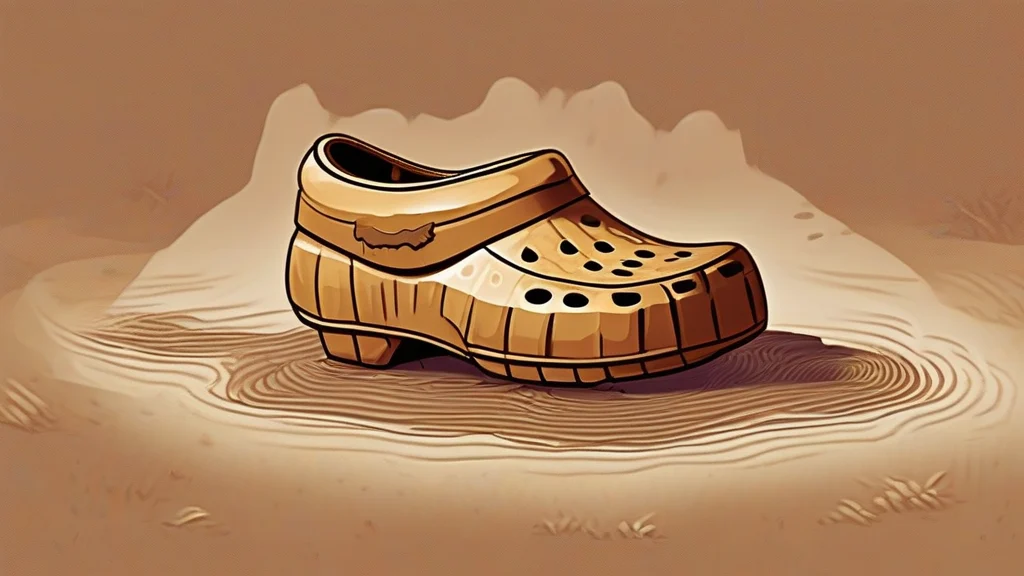
Croc is an informal noun with two well-established senses. Its older and still dominant meaning is a shortened form of crocodile, used especially in British, Australian, and African English when talking about these large predatory reptiles, as in 'a big croc basking on the bank'. Since the early 2000s the word has acquired a second, entirely unrelated sense: an individual shoe of the lightweight foam clogs sold under the Crocs brand, so that 'wearing my crocs' is now everyday speech worldwide. Both uses are casual rather than formal, and context almost always makes clear which is meant — nobody confuses a reptile with a slip-on shoe for long. The word derives simply by clipping from crocodile, which itself traces through Latin and Greek to words describing lizard-like creatures of the Nile. Compact, vivid, and instantly recognizable, croc works equally well in wildlife documentary narration and weekend errand-running, making it a small but genuinely interesting case of one word serving two very different worlds.
nounAn informal, chiefly British shortening of 'crocodile'. Also the informal name for a type of lightweight foam clog shoe made by Crocs, Inc.
- An informal shortening of 'crocodile', used especially of large or dangerous crocodilians.
- Informally, a single shoe of the lightweight resin clog brand Crocs.
"We spotted a croc basking on the riverbank at dusk."
"The tour guide warned us not to swim where crocs had been seen."
"He slipped on his crocs and headed out to water the garden."
Pluralizes normally; 'crocs' commonly refers to a pair of the brand-name shoes.
"She keeps her crocs by the back door all summer."
'Croc' does double duty in modern English — one syllable that can mean a man-eating reptile or the world's most divisive plastic shoe.
Reviewed by Deb Chak, Editor. AI-assisted content curated by RJS Tech Solutions LLP.
Etymology of croc
As a clipped form of 'crocodile', croc emerged through informal English usage, with the full word tracing back through Latin crocodilus to Greek krokodeilos, the name applied to Nile lizards in ancient Greece. The footwear sense arose separately in the early 21st century as a clipping of the brand name Crocs, introduced in 2002, and spread rapidly through colloquial use.
Related word forms
How croc is actually used
Both senses are informal. The reptile sense is common in Australian and British English and in wildlife contexts; the footwear sense is widespread globally among younger speakers.
Easily confused with croc
A crock is an earthenware pot or jar (or informally, nonsense talk), whereas a croc is a crocodile or a Crocs-brand shoe.