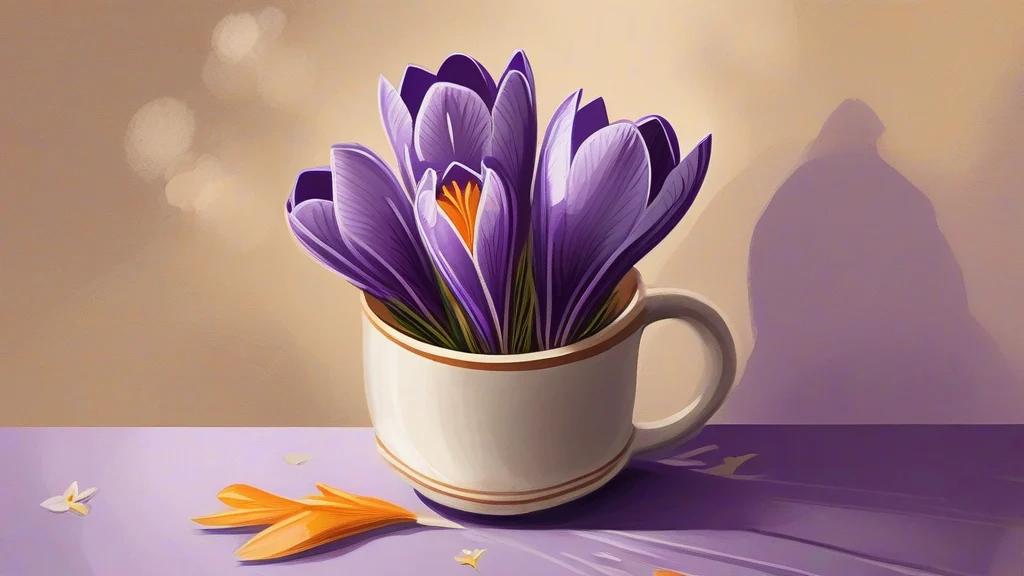
What does crocus mean?
A crocus is a low-growing perennial plant belonging to the genus Crocus within the iris family, Iridaceae, prized in gardens for its cheerful cup-shaped blooms that appear in late winter or early spring, sometimes pushing directly through snow. The flowers range across purple, yellow, lavender, and white, rising from small bulb-like underground stems called corms. Gardeners plant crocus corms in autumn to enjoy some of the earliest colour of the new year, and the sight of crocuses opening has long symbolised hope and renewal. One species holds particular economic and cultural importance: Crocus sativus, the saffron crocus, produces the three deep-red stigmas that, once hand-harvested and dried, become saffron — by weight, the most valuable spice in the world. Note that the so-called autumn crocus (Colchicum) is an entirely different and highly poisonous plant despite its similar appearance. Whether admired in a spring border or valued on a spice trader's scale, the crocus occupies a distinctive place in both horticulture and human history.
nounA crocus is a small spring-flowering plant of the iris family (Iridaceae), with cup-shaped flowers in shades of purple, yellow, or white that often bloom through snow. The dried stigmas of one species, Crocus sativus, are the source of the spice saffron.
- A small spring-blooming plant of the genus Crocus in the iris family, grown from corms for its showy cup-shaped flowers.
- The saffron crocus (Crocus sativus), whose dried stigmas yield the spice saffron.
"The first purple crocuses pushed up through the last of the snow in late February."
"Golden crocuses dotted the lawn weeks before any other flower appeared."
"Farmers harvest saffron by hand at dawn, plucking the delicate stigmas from each crocus blossom."
In informal British gardening contexts, 'crocus' may be treated as uncountable, but 'crocuses' is the accepted plural form in careful writing.
"Thousands of crocuses carpeted the park meadow in early March."
The world's most expensive spice, saffron, comes from just three tiny stigmas hand-picked from each crocus flower — it takes roughly 150,000 flowers to make a single kilogram.
Reviewed by Deb Chak, Editor. AI-assisted content curated by RJS Tech Solutions LLP.
Etymology of crocus
The word 'crocus' derives from Latin crocus, which itself was borrowed from Greek krókos (κρόκος), the ancient name for the saffron plant. Some scholars trace the Greek word further back to a Semitic source, though the exact route remains uncertain. English adopted the word in the Middle Ages, largely through Latin botanical texts, and it has been the standard English name for the genus ever since. Cognate forms appear across European languages, including French crocus and Italian zafferano-derived terms connected to the spice trade.
How crocus is actually used
Crocus is used as both singular and plural in informal British usage ('a bed of crocus'), though 'crocuses' is the standard plural in American English. The term 'autumn crocus' refers to Colchicum autumnale, which is not a true crocus. The word carries gentle, hopeful connotations as an emblem of early spring and resilience.
Easily confused with crocus
Colchicum, commonly called autumn crocus, is a poisonous plant of the lily family that resembles true crocus but is unrelated and toxic if eaten.