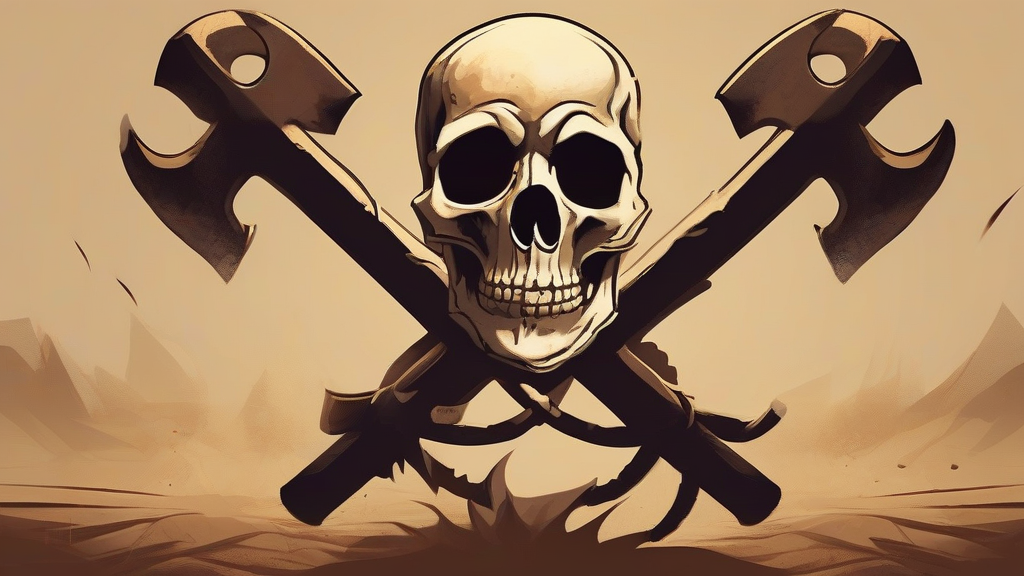
What does crossbones mean?
"Crossbones" refers to two long bones crossed in an X-shape, almost always depicted together with a human skull to form one of the world's most recognizable symbols: the skull and crossbones. This emblem signals death, lethal danger, or poison, appearing on hazardous-chemical labels, toxic-product warnings, and gravestone carvings across many cultures. Its most famous historical use was on pirate ships, where a black flag bearing the design — known as the Jolly Roger — was raised to intimidate target vessels into surrendering without resistance. Because it so rarely stands alone, the word "crossbones" functions chiefly as part of the compound phrase "skull and crossbones," which is firmly embedded in everyday language, signage, literature, and film. Beyond its grim literal associations, the image carries strong connotations of adventure, rebellion, and gothic drama, making it a staple of pirate costumes, Halloween decorations, and popular culture. Understanding the term means recognizing both its practical role as a hazard symbol and its enduring cultural power as an icon of danger and daring.
nounA representation of two bones crossed in an X shape, typically depicted beneath or alongside a human skull, used as a symbol of death or danger. It is most familiar as part of the skull-and-crossbones emblem.
- Two bones crossed in an X-shape, especially when paired with a skull, as an emblem of death, poison, or danger.
- The complete skull-and-crossbones device itself, as displayed on flags (the Jolly Roger), warning labels, and hazardous-substance signage.
"The old pirate flag showed a white skull and crossbones on a field of black."
"The bottle bore a stark label: a skull and crossbones above the word 'poison'."
"Children dressed as pirates for Halloween, many carrying flags emblazoned with crossbones."
The skull and crossbones flew on pirate flags not to celebrate death, but to terrify victims into surrendering without a fight — the ultimate psychological weapon.
Reviewed by Deb Chak, Editor. AI-assisted content curated by RJS Tech Solutions LLP.
Etymology of crossbones
The word derives from "cross," meaning shaped like a cross or X, combined with "bones," referring to the skeletal elements depicted. Both components trace back through Middle English: "cross" from Old Norse "kross" (ultimately from Latin "crux") and "bone" from Old English "bān." As a compound describing the crossed-bones emblem, "crossbones" emerged in English usage by around the early 17th century, coinciding with the height of Atlantic piracy, when such designs appeared on sailors' flags. It shares its Germanic root "bān" with words such as "bony" and "bonfire" (originally a fire of bones), reflecting deep common ancestry rather than borrowing.
How crossbones is actually used
"Crossbones" is almost never used alone; it nearly always appears within the fixed phrase "skull and crossbones." The tone is inherently ominous but also strongly associated with piracy, adventure fiction, and Halloween imagery. Register: neutral to informal; common in everyday speech, signage, and popular culture rather than formal writing. In British English the pronunciation typically ends with /əʊn/ in "bones", while American English uses /oʊn/.
Easily confused with crossbones
A crossbow is a medieval ranged weapon that fires bolts, while crossbones refers to crossed bones forming a symbol of death.