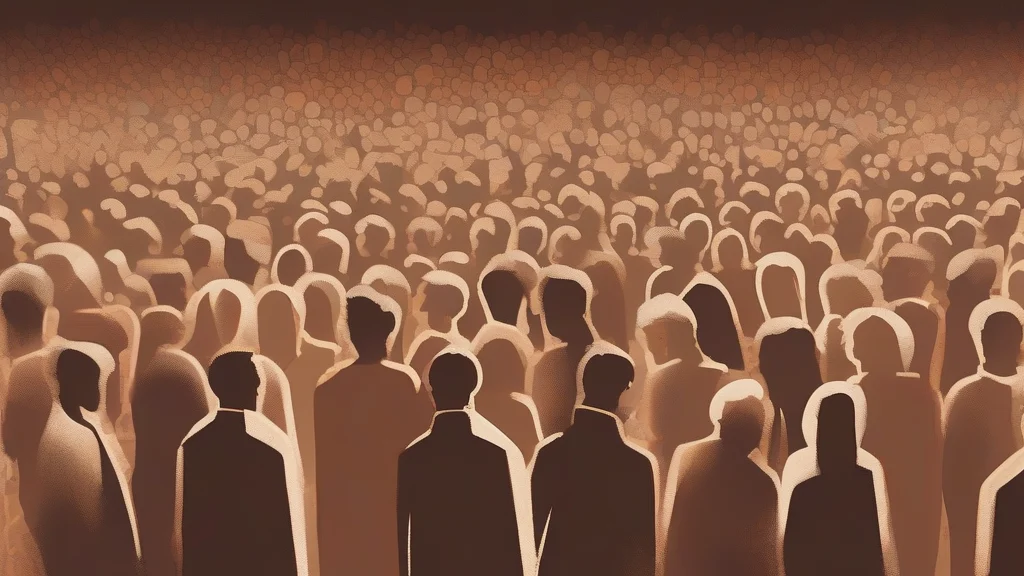
What does crowd mean?
A crowd is a large number of people gathered close together in one place, whether at a concert, a sporting event, a protest, or a busy street. The word also functions as a verb: when people or things crowd a space, they fill it so tightly that movement is difficult. Beyond its literal sense, crowd carries figurative weight — English speakers speak of 'blending into the crowd' to describe anonymity within a group, and informally refer to 'the crowd' to mean a particular social circle or set of associates, as in 'she runs with a fast crowd'. While generally neutral, the word can acquire negative overtones when it suggests disorder, pressure, or unthinking conformity, echoing the related sense of a mob. Its versatility across literal, figurative, and social registers makes it one of the most frequently used words for describing human gatherings.
A large group of people gathered closely together, especially at a public event or in a public place.
"The crowd erupted in cheers when the team scored."
Also used informally to mean a person's social circle: 'the in-crowd'.
To fill a space so that it seems too full, or to press closely around someone or something.
"Fans crowded around the stage after the show."
The plural often refers to multiple gatherings or to large numbers of people in general, as in 'crowds flocked to the festival'.
"Huge crowds lined the streets for the parade."
The word crowd once meant a fiddle — before it came to mean a crush of people, it was an ancient stringed instrument.
Reviewed by Deb Chak, Editor. AI-assisted content curated by RJS Tech Solutions LLP.
Etymology of crowd
The noun crowd derives from Middle English 'crude' or 'crowde', which originally denoted a crowd, press, or throng, and is likely related to the verb's sense of pressing or pushing. The verb crowd comes from Old English 'crudan', meaning to press, push, or drive, cognate with Dutch 'kruyden' and related to the notion of curdling or pressing milk into curds. An older, separate sense of crowd as a noun — an ancient stringed instrument like a fiddle, from Welsh 'crwth' — survives only in historical usage. The modern senses of a massed gathering of people became established by the late medieval and early modern periods.
Related word forms
How crowd is actually used
Crowd is neutral in most contexts but can carry negative connotations when it implies disorder or loss of individuality, as in 'mob' or 'follow the crowd'. The informal sense meaning one's social circle is common in British and American colloquial speech ('the college crowd').
Easily confused with crowd
Crown means a royal headpiece or the top of something (and rhymes with crowd), while crowd refers to a mass of people or pressing together.