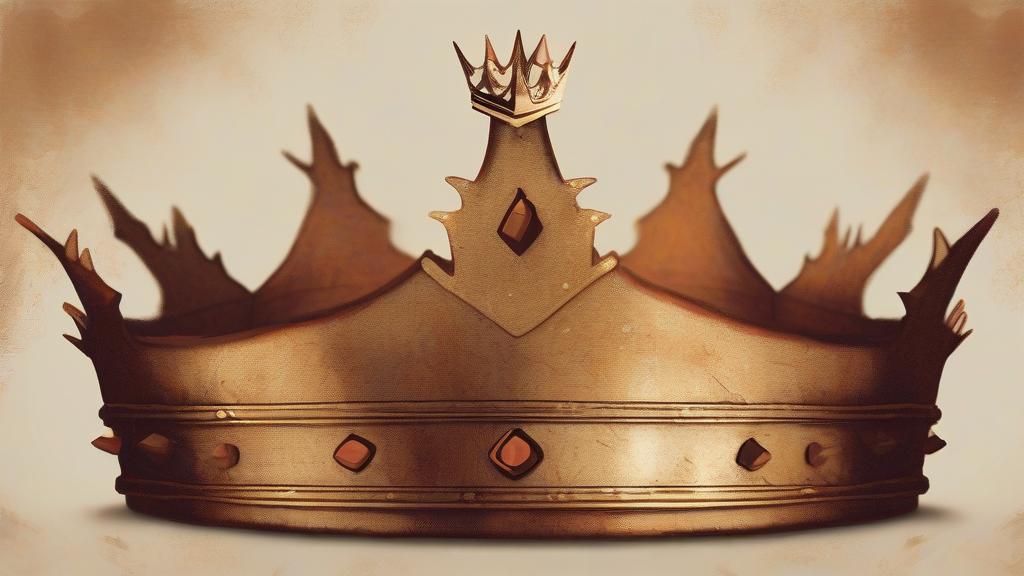
What does crown mean?
A crown is an ornamental headdress, typically of gold and jewels, worn by monarchs as a visible emblem of their sovereignty. Beyond its literal form, the word extends to the abstract idea of royal authority itself: in Britain, 'the Crown' refers to the state acting under the monarch's name, as in Crown courts or Crown property. The word also describes the highest point of things — the crown of the head, of a hill, of a hat — and the exposed portion of a tooth, whether natural or artificial. As a verb, to crown someone is to place the diadem on their head at a coronation, or figuratively to bring an endeavor to its finest completion, as when a career is 'crowned with honors'. Rich with connotations of triumph, dignity, and culmination, crown is among the most evocative words in English, linking physical objects, political institutions, and metaphorical peaks of success.
An ornamental headpiece of precious metal and jewels worn by a monarch as a symbol of sovereignty; by extension, the power or authority of the monarchy, or the highest part of something such as the head, a hill, a tooth, or a tree.
"The king's crown was set with rubies and emeralds."
In British usage, capitalized 'the Crown' refers to the state or sovereign's legal authority rather than the physical object.
To place a crown upon someone's head, especially in formally investing them with monarchical power; or figuratively, to complete or perfect something with final distinction.
"They crowned her champion after she won the final match."
The figurative use — 'crowned with success' — is common in formal writing and speech.
Standard pluralization; used both for multiple literal headpieces and for figurative or botanical senses (e.g. tree crowns).
"The museum displayed several ancient crowns from different dynasties."
The British Crown Jewels include the Cullinan I diamond, cut from the largest diamond ever found — a staggering 3,106 carats in its rough state.
Reviewed by Deb Chak, Editor. AI-assisted content curated by RJS Tech Solutions LLP.
Etymology of crown
The English word crown derives from the Latin corona, meaning 'garland' or 'wreath', which entered Old French as coroune before passing into Middle English around the twelfth century. The same Latin root gives us related terms such as coronation, corolla (the inner ring of petals in a flower), and even coroner, originally the officer who represented the Crown in judicial matters. Its lineage thus ties the modern English word directly to ancient Roman symbols of honor, where wreaths were awarded to victors and civic leaders long before they signified hereditary monarchy.
Related word forms
How crown is actually used
'Crown' carries strong connotations of royalty, achievement, and supremacy. In British English, 'the Crown' specifically denotes the state or sovereign's legal authority (as in 'Crown property'). The verb sense of crowning often appears figuratively, meaning to culminate or perfect an accomplishment.
Easily confused with crown
A clown is a comic entertainer, while a crown is a royal headpiece or symbol of authority — they rhyme but mean entirely different things.
A crone is an old woman (often used pejoratively), whereas a crown is a headpiece symbolizing monarchy.