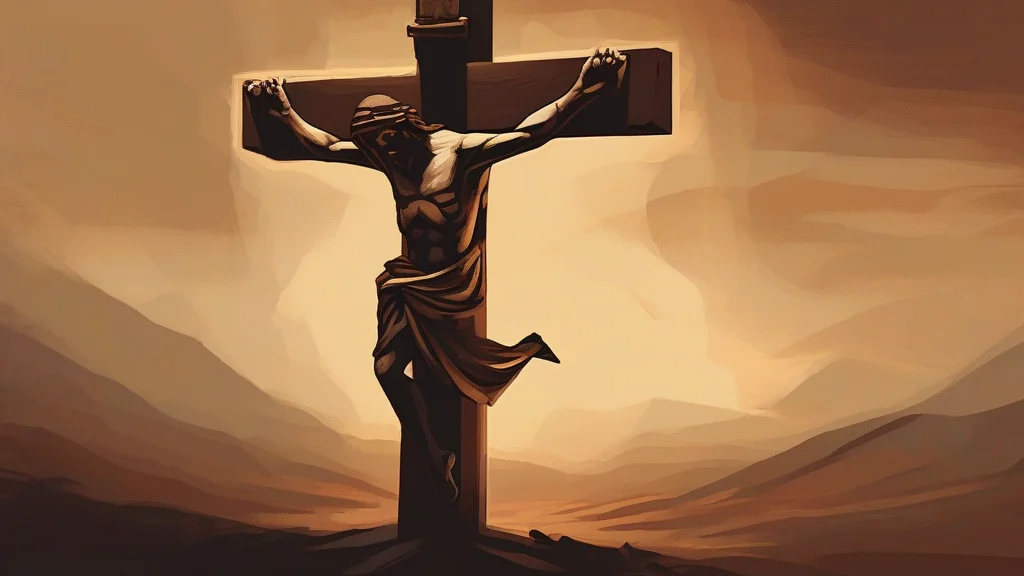
What does crucifixion mean?
Crucifixion is the act of executing someone by fastening or binding them to a cross, a method of capital punishment employed widely in the ancient world, most famously by the Romans. Because it was slow, painful, and deliberately humiliating, Rome reserved it for slaves, pirates, rebels, and other lower-class offenders, while citizens generally escaped it. The word's enduring resonance comes above all from Christianity: the crucifixion of Jesus of Nazareth under Pontius Pilate is the pivotal event of the faith, commemorated on Good Friday and depicted in countless works of art. Beyond religion, crucifixion survives as a vivid metaphor for intense suffering or savage criticism — a film may be said to receive a critical crucifixion, for instance. Derived from Latin roots relating to the cross, the word connotes agony, shame, and sacrifice, making it one of the most emotionally charged terms inherited from antiquity.
nounThe act or practice of executing a person by fastening them to a cross, historically used as a form of capital punishment in the ancient world. It also refers figuratively to any severe suffering, torment, or harsh treatment.
- The execution of a person by fastening them to a cross.
- Figuratively, extreme suffering, torment, or harsh treatment.
"Under Roman law, crucifixion was reserved chiefly for slaves, rebels, and the most serious criminals."
"Historians believe thousands of people were subjected to crucifixion in the ancient Mediterranean world."
"The critics' reviews amounted to a public crucifixion of the once-celebrated director."
Rare except when referring to multiple historical instances of the practice.
"Archaeologists have found skeletal remains suggesting several crucifixions occurred at the site."
Crucifixion was so shameful a punishment that Roman citizens were largely exempt from it — Cicero called it 'the most cruel and disgusting penalty.'
Reviewed by Deb Chak, Editor. AI-assisted content curated by RJS Tech Solutions LLP.
Etymology of crucifixion
Crucifixion derives from the Latin crucifixio, formed from crucifigere ('to fix to a cross'), which combines crux ('cross') with figere ('to fasten'). English adopted the term via Old French in the medieval period, alongside the related verb crucify. The same Latin root crux also gives English crucial, excruciating, and crusade, all preserving the notion of the cross as something decisive or painful.
Related word forms
How crucifixion is actually used
In religious contexts the word carries deep solemnity and is central to Christian theology regarding the death of Jesus. In secular use it appears mostly in figurative expressions about harsh criticism or punishment, where its gravity lends rhetorical force.
Easily confused with crucifixion
A crucifix is a cross bearing the figure of Christ, an object; crucifixion is the act of execution itself.