What does crudites mean?
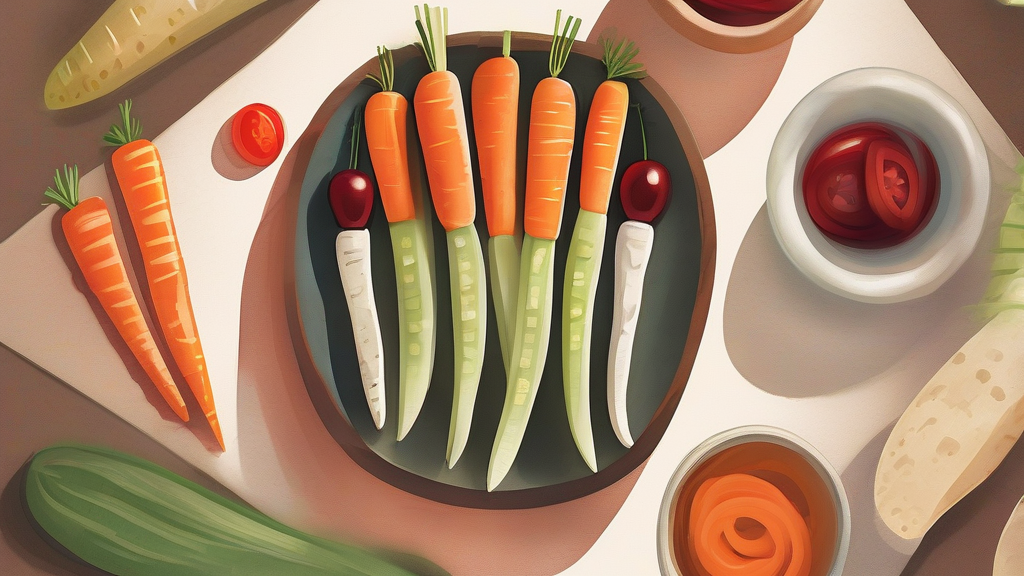
Crudités are raw vegetables — commonly carrots, celery, bell peppers, cucumbers, radishes, and cauliflower — trimmed and cut into strips or florets and served cold as an appetizer or party snack, almost always accompanied by a dipping sauce such as vinaigrette, aioli, hummus, or ranch dressing. Borrowed directly from French, where the term is itself a plural, the word entered English in the twentieth century and retains its continental flair; it is treated as an invariant plural noun in English usage. Crudités carry a connotation of fresh, healthy, slightly elegant entertaining, appearing on restaurant menus, at cocktail parties, and on grazing tables. They differ from cooked vegetable sides or salads in being entirely raw, and they occupy a niche alongside canapés and hors d'oeuvres as a classic opener to a meal. For hosts and food writers alike, the word signals simplicity done well: crisp produce, a good dip, and little else.
nounRaw vegetables cut into strips or pieces and served as an appetizer or snack, typically with a dip such as aioli, vinaigrette, or hummus.
- Raw vegetables (such as carrots, celery, peppers, cucumbers, and cauliflower) cut into bite-sized pieces and served as an appetizer, usually with a dip.
"A platter of crudités with saffron aioli greeted the guests as they arrived."
"The caterers arranged a colorful array of crudités around a bowl of herb dip."
"For a light starter, she offered crudités alongside olives and warm bread."
Crudités is already a plural form borrowed from French and does not take an additional plural ending in English; the singular 'crudité' exists but is seldom used.
"She set out several trays of crudités before the guests arrived."
Borrowed straight from French, 'crudités' literally traces back to the Latin word for 'raw' — the same root that gives us 'crude'.
Reviewed by Deb Chak, Editor. AI-assisted content curated by RJS Tech Solutions LLP.
Etymology of crudites
Crudités comes from French, where 'crudité' denotes rawness or uncooked food, ultimately deriving from the Latin 'crudus', meaning raw or unripe — the same root that produced English 'crude' and 'crudity'. The French plural 'crudités' was borrowed into English in the twentieth century to describe platters of raw vegetables served with dips. Its Latin root also underlies related terms such as 'recrudescent', which describes something breaking out afresh.
Related word forms
How crudites is actually used
Always used as a plural mass noun in English; the singular 'crudité' is rare. The word carries a slightly upscale, culinary connotation — it appears most often on menus and in food writing rather than everyday speech. It is frequently written without the accent ('crudites') in English text.
Easily confused with crudites
Croutons are small cubes of toasted or fried bread, whereas crudités are raw fresh vegetables served with a dip.