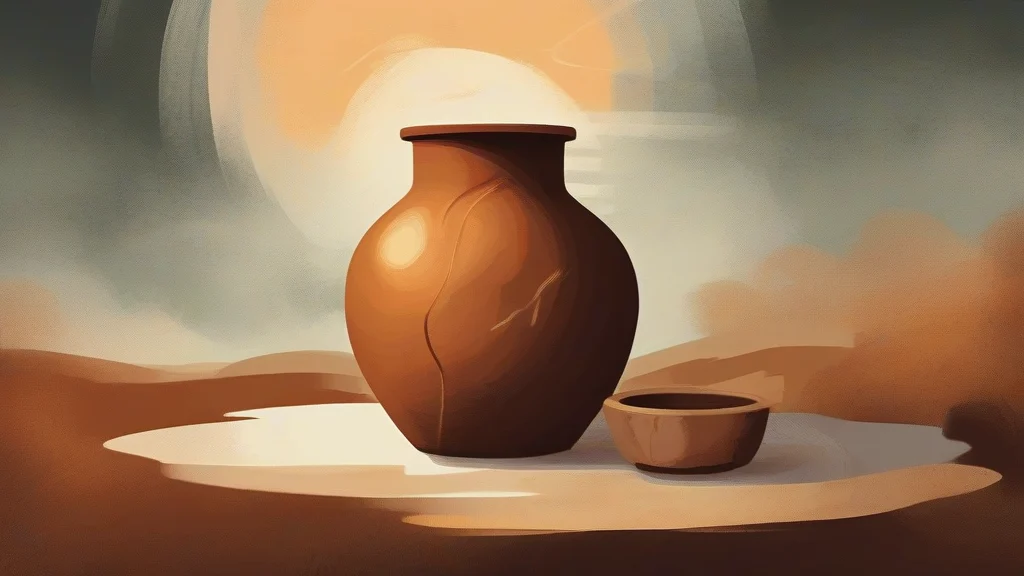
What does cruse mean?
A cruse is a small earthenware pot or vessel, traditionally used for holding liquids — most often water, oil, or wine. The word has ancient roots: it appears frequently in Bible translations, where it describes humble household jars, most famously the widow of Zarephath's cruse of oil, which God kept miraculously full. That episode left a permanent mark on English in the idiom "the widow's cruse," meaning any seemingly inexhaustible source of supply. Although once part of ordinary vocabulary, cruse today is rare outside literary, biblical, and antiquarian contexts; a reader encountering it is most likely to find it in older texts, poetry, or discussions of scripture. Its meaning overlaps with words like jar, jug, and flask, but its connotation is distinctly old-fashioned, evoking simple domestic life in earlier eras. Because it sounds nearly identical to the common word "cruise," careful spelling matters: drop the "i" and you move from ocean liners to ancient pottery.
A small earthenware pot or jar used for holding a liquid such as water, oil, or wine.
"She carried water from the well in a battered clay cruse."
Now largely confined to literary, biblical, and historical writing.
Specifically, such a vessel in biblical narrative, as in the story of the widow of Zarephath whose cruse of oil was miraculously replenished.
"The barrel of meal shall not waste, neither shall the cruse of oil fail."
This sense underlies the idiomatic expression "the widow's cruse."
Standard regular plural; rarely needed given the word's infrequency.
"The archaeologists catalogued several intact cruses alongside larger storage jars."
In the Bible, a poor widow's cruse of oil miraculously refilled itself — and that story gave English the phrase "the widow's cruse," still used for an inexhaustible source of supply.
Reviewed by Deb Chak, Editor. AI-assisted content curated by RJS Tech Solutions LLP.
Etymology of cruse
Cruse entered Middle English from Old French "crue," denoting an earthenware pot, with the French term ultimately traced to Germanic origins related to vessels made of baked clay. It has been used in English since medieval times and became especially familiar through its appearance in early Bible translations, where it rendered Hebrew terms for small jars of oil and water. Its survival into modern English owes much to those scriptural associations rather than to continued everyday use.
How cruse is actually used
"Cruse" is now rare in everyday speech and belongs mostly to literary, historical, or biblical registers; modern readers meet it mainly through set phrases like "the widow's cruse." It should not be confused with the far more common "cruise."
Easily confused with cruse
"Cruise" means a sea voyage or to travel leisurely, while "cruse" (with no 'i') is a small earthenware vessel for holding liquid.
A crevasse is a deep crack in a glacier or the earth, whereas a cruse is a small container for liquids.