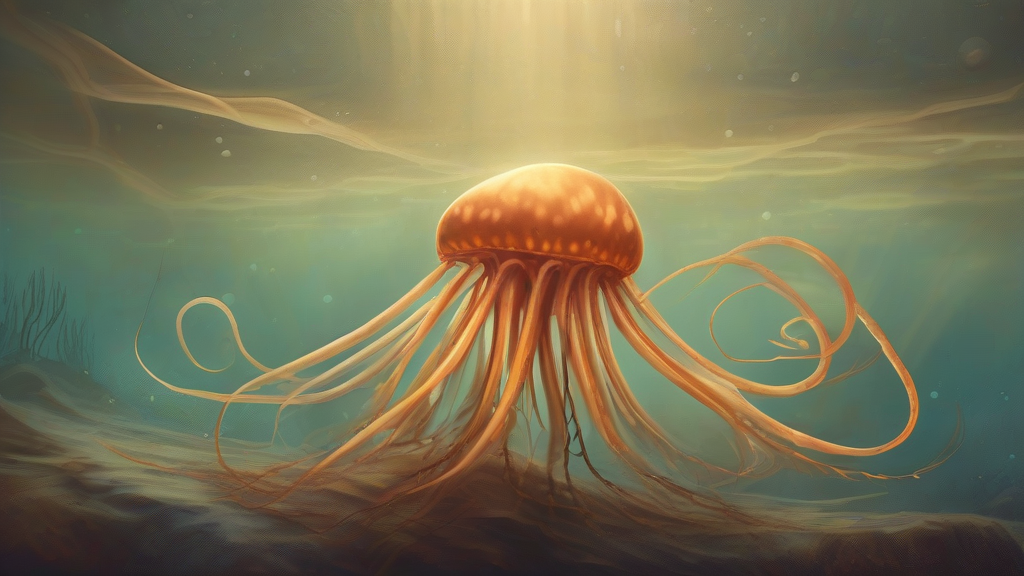
What does ctenophore mean?
A ctenophore is any marine invertebrate belonging to the phylum Ctenophora, a group of soft-bodied, transparent sea animals commonly known as comb jellies or sea gooseberries. Despite a superficial resemblance to jellyfish, ctenophores are not closely related to them: instead of pulsing bells and stinging cells, they move through the water by means of eight rows of comb-like plates made of fused cilia, whose beating scatters light into shimmering bands of color. Most species are planktonic predators that feed on small crustaceans and other larvae, often using sticky cells called colloblasts rather than venom to capture prey. The word is primarily encountered in scientific and marine-biology contexts, where it serves as both a singular and plural term. Ctenophores hold special fascination for biologists because some studies place them at the very base of the animal evolutionary tree, making them a key subject in debates about how animal life first diversified.
nounA marine invertebrate of the phylum Ctenophora; a soft-bodied, gelatinous sea animal, commonly called a comb jelly, that propels itself through the water using rows of fused cilia known as comb plates.
- Any marine invertebrate of the phylum Ctenophora, commonly called a comb jelly or sea gooseberry, characterized by eight rows of ciliated comb plates used for swimming.
"The aquarium's newest exhibit features a tank of glowing ctenophores drifting slowly through the darkened water."
"Biologists have long debated whether the ctenophore was the first lineage to split from the rest of the animal kingdom."
"At night, the bay's ctenophores flash with iridescent light as their comb plates beat in unison."
Standard regular plural; the word also functions collectively when referring to the group as a whole.
"Ctenophores drift through every ocean, from surface waters to the deep sea."
Despite their jellyfish-like looks, ctenophores may be the earliest branch of the entire animal family tree — and they hunt using the world's only known natural biological lasers.
Reviewed by Deb Chak, Editor. AI-assisted content curated by RJS Tech Solutions LLP.
Etymology of ctenophore
The word ctenophore derives ultimately from Ancient Greek: 'kteis' meaning 'comb', referring to the animal's distinctive rows of ciliated comb plates, combined with '-phore' from the Greek verb 'pherein', meaning 'to bear' or 'to carry'. The name thus literally means 'comb-bearer'. It was coined in the nineteenth century as part of the formal naming of the phylum Ctenophora, and shares its two roots with other learned terms such as semaphore and chromatophore (from 'pherein') and ctenoid (from 'kteis').
How ctenophore is actually used
A technical term used chiefly in biology and marine science writing; general readers more often encounter these animals under the common name 'comb jelly'. The word is always applied to members of the phylum Ctenophora as a whole rather than to one species.
Easily confused with ctenophore
A cnidarian (such as a true jellyfish, coral, or sea anemone) belongs to a different animal phylum and typically has stinging cells called cnidocytes, which ctenophores lack.